The Idea Of Her
The Patron Saint of Horny Moms Everywhere
With The Idea of You, Robinne Lee turned on a generation of middle-aged women. In her new novel, Crash Into Me, she experiments with edgier territory still.
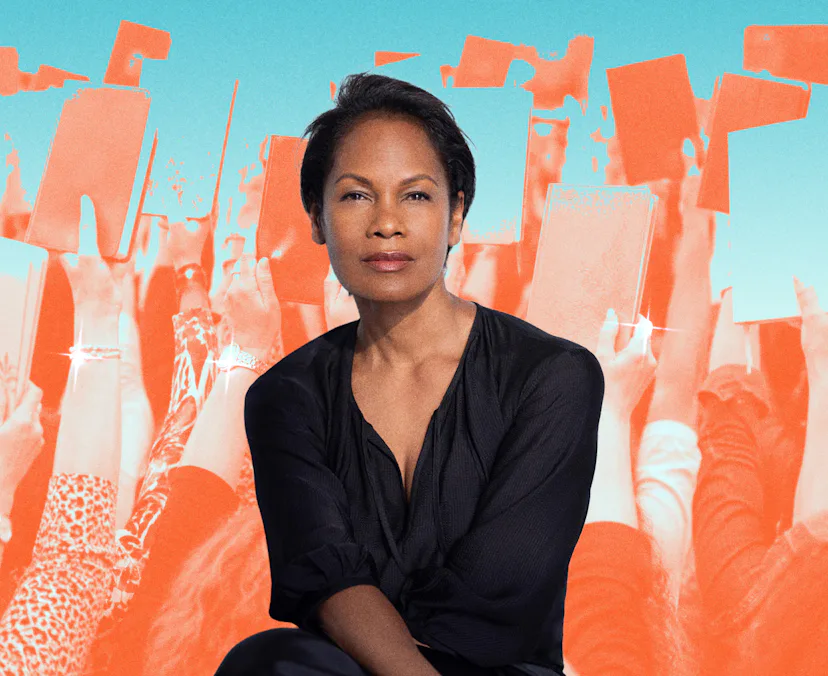
There’s an icon among us at the Javits Convention Center, a blockbuster author whose fans — and book publisher — have been desperate for their next fix: Robinne Lee. Lee’s debut novel, 2017’s thoroughly delectable The Idea of You, was a stylish Mrs. Robinson story that wound up selling more than 1 million copies and inspiring a hit movie starring Anne Hathaway.
The book came out nine years ago, which is the length of the Bronze and Stone Ages combined on planet BookTok. So it makes a certain sense that none of the lilac-haired bibliophiles and “shadow daddies” swooping around the convention hall in their big prosthetic wings have noticed the identity of the woman enjoying an embrace with a cardboard cutout of Connor Storrie. Lee studies the selfie she’s snapped and grins. “My sister is going to flip out,” she says, her thumbs hurrying over the phone. “Nobody else in our family understands, but this man is our love language.”
Fresh off an hourlong meet and greet with fans who’d reserved tickets, Lee has 45 minutes before the next event at BookCon, a live podcast taping in an auditorium the size of a Texas megachurch. Cutting a gamine figure in her trench coat and silk scarf tied around her swanlike neck just so, she has the slightly sneaky air of a big shot returning to the spot where it all started. Like any champion coming back from an extended hiatus, she’s not just ready for Round 2; she’s looking forward to it.

The cultural winds are in Lee’s sails. Her pivot from Hollywood actor to novelist in 2017 neatly lined up with the beginning of a new wave of books that are unabashedly horny. (“Are We in a ‘Smut Renaissance’?” asked a recent New York Times headline.) Just like Heated Rivalry was a little Canadian story about gay hockey players, The Idea of You was yet another paperback on the women’s fiction table. That is, until it lit a match within a sizable swath of women of a certain age, women who craved something one step more cerebral than the mass-market bodice-rippers already seeing a revival. “And it’s still selling,” says Elizabeth Beier, Lee’s editor at St. Martins Books.
Lee’s feverishly awaited follow-up, Crash Into Me, will finally hit shelves on July 7. A sapphic romance set in the Manhattan fashion world of the 1990s and the contemporary art and private-school scenes of current-day Los Angeles, it’s a darker, more complex work than the book that put her on the map (via its steamy audiobook, in the cars of moms waiting in carpool lines everywhere, their fingers hovering on the pause button).
The Idea of You was a yummy read driven by a single concept: What if a middle-aged mom ends up in the arms of her teen daughter’s favorite pop star? Crash doesn’t have a Harry Styles stand-in for romantic lead. It’s a more layered affair, spanning across communities and time periods and stirring up questions to do with power, seduction, and the dark arts that women use to ensorcel each other. Themes of race and sexual assault enter the mix. “They’re very different books, but in both cases, they’re commercial fiction written at an elevated level,” Beier says.
“It all came so fast: #MeToo, the pandemic, and Black Lives Matter, and all the police violence,” she says. “I was in a heavy place, and how was I going to be writing something light and fluffy when all these things were happening around me?”
Lee’s prose has a soft quality, the linguistic equivalent of very good lighting. Her style is the opposite of sloppy or rushed — in writing and in real life. Now with her chic taupe shift dress in view under the trench coat, she circles the convention floor with the grace of somebody who made a living for several years working as an actor in Los Angeles, landing roles in Hitch and Fifty Shades Darker before deciding that she was sick and tired of the industry’s skin-deep casting choices. She’d had it with the implication that everybody has a sell-by date, one that’s generally just a couple of decades after they were born. Why get the short end of somebody else’s playbook when you can write your own?
Crash mirrors many of the contours of its author’s life. (Lee’s pull toward autofiction might be what prompted a close friend to call her work “Cusk-ian,” referring to the British author Rachel Cusk, who has called traditional fiction “fake and embarrassing.”) Lee is of Jamaican and Chinese descent; has a son and daughter; and is married to a five-o’clock-shadowed husband, film producer Eric Hayes. The two went on a date as undergraduates at Yale and reconnected years later via a class listserv; he wooed her with the help of a hot-air balloon ride and weekend in Napa Valley.
In the circus-mirrored reflection of Lee’s own life, things take a much different turn. After narrator Cecilia’s film-director husband has an indiscretion with a young French actress, the couple moves from Paris to a “multi-million-dollar treehouse” in Los Angeles. Feeling adrift, she’s moved to rekindle a friendship — that blooms into something more — with retired supermodel Anouk. “I’ve always found women attractive, not to the degree that I find men attractive. So it wasn’t like I’m questioning my sexuality,” Lee says when asked about her own homosexual experimenting (none, maybe if she’d been born to Gen-Z). “I’m questioning everything else though.”
“Attraction is about wanting to please the person you’re with,” she says. “There’s a pleasure to that, and it becomes its own gift to you, that you have that power and control.”
The characters’ chance encounter leads to a sapphic love affair that unspools at a sensationally erotic burn. The two meet up for lunches and take “girls trips” to luxury getaways, carrying on right under everyone else’s noses while Cecilia’s spectacularly rich husband bestows her with all the trappings of the gilded life. The book is packed with a level of detail that feels scandalous on a visceral level. Should a female reader wonder what it’s like to be intimate with a member of the same sex, this book does quite a bit of the imaginative heavy-lifting.
The intimacy Cecilia and Anouk share hovers on the fine line between imitation and infatuation. “It’s like when I look at a model and I think: ‘I want to wear whatever you’re wearing. I want to wear that fragrance. I want to try this mascara,’” Lee says. “And at the same time, I want to be you and devour you.”
Lee talks about imagining what it’s like to have sex with a woman as if laying out a logic problem that’s simple to solve. “The more I thought about those things, the more I found myself thinking about the things we normalize,” she tells me, citing a boy in her fifth grade class who she was in the middle of an argument with when he instructed her to suck his dick, a term she had never heard before. “I remember thinking, that is the most disgusting thing I have ever heard. Like, I can’t even create that image in my brain.”
Around four decades later, her brain had an easier time drafting a playbook for two women. “Attraction is about wanting to please the person you’re with,” she says. “There’s a pleasure to that, and it becomes its own gift to you, that you have that power and control.”

Lee is a magpie, collecting bits and pieces from the various worlds she has touched down on, and repurposing them in her novels. It’s a process that leaves her stories, however fantastical they may be, with a sense of lived-in authenticity. When Lee doesn’t know what she’s writing about, she knows how to do the legwork. In the case of writing about the art world in The Idea of You, that meant approaching a school mom who happened to run an art gallery.
“When you run an art gallery in Los Angeles, you get used to people asking you about how the art world works for the sake of research,” says Mary Leigh Cherry, who co-founded Cherry and Martin before setting up her own arts consultancy, and who has come to be Lee’s unofficial art-world adviser. “People usually want to talk to make sure they get the details right, and then they go ahead and still get a lot wrong about the art world.” Not the case with Lee, who sets up multiple meetings with Cherry to go over every last detail and who got the art bug herself. “It’s been lovely going to art fairs with her and watching her speak the language with utter fluency,” Cherry says.
Contemporary women’s fiction was another language that Lee had to learn on the fly. Friends who read the first draft of The Idea of You pointed out ways she’d need to revise it to satisfy the demands of the romance market. For one thing, the main character was a single woman nearing 40 but she wasn’t frazzled and desperate. The sex scenes had their own choreography that wasn’t familiar to readers. And the ending veered way off formula. She was going to need to fix her romance novel before she showed it to anyone else, they told her. “But I always thought of it as a love story,” Lee says, her eyes narrowing as if lost in reverie. “I never set out to write a romance novel. There’s a difference.”
In 2016, St. Martin’s bit, despite the novel not fitting neatly into an existing box. Initial sales were perfectly respectable. What happened next was the stuff of every publisher’s dreams. Word got out about the book that dared to depict its single mom not as a scatterbrained sad sack, but as a fully embodied art gallery owner. At last, here was a reading marathon-ready book with a heroine for the thinking woman.
Vogue cemented the novel’s cool-girl status when it ran an article calling it “the sleeper hit of the pandemic.” The Idea of You sold around 1 million copies, came out in 24 languages, and was adapted into a 2024 film starring Anne Hathaway that wasn’t half bad. It didn’t hurt that books like Miranda July’s All Fours and Jen Beagin’s Big Swiss were also breaking out and breathing new life into fiction about middle-aged women. Here was proof that, for a certain ilk of woman, the party was far from over.

Lee is exactly that sort of woman herself. She’s been living in France since 2022, when her family moved there after decades in Los Angeles. “Back when my husband and I first got together, I told him that one day I wanted to move to Paris, and he said that one day we could do that,” she says.
Their son and daughter, now in college and in high school, were remarkably good sports about it. Lee’s son even liked Paris enough to stick around, and he is now enrolled in fashion school there. His sister is eyeing colleges in the United States, and has been lobbying for a mother-daughter trip to Japan. Her campaign has been persuasive, judging by the fact that Lee is studying Japanese on Duolingo.
Moving across the world was easier than coming up with a second book. “I had all these fans who wanted another book just like The Idea of You, and I wasn’t sure I could give them what they were expecting,” she says. Call it sophomore slump, or writer’s block, or something bigger than any of that. “It all came so fast: #MeToo, the pandemic, and Black Lives Matter, and all the police violence,” she says. “I was in a heavy place, and how was I going to be writing something light and fluffy when all these things were happening around me?”
She gave herself permission to go a little darker and explore themes of race and memory and sexual violence. And to delve into the all-female love story, something that Lee had yet to allow herself to explore. Growing up in the 1980s and ’90s, the sexuality spectrum didn’t work on a sliding scale, she says. For straight women like Lee, women were to be emulated, men to be desired. “It was not as open and accepting a time,” she explains. “People weren’t fluid in the way that they are now. It felt like if you did one thing, then that was your label forever.”
“It’s like when I look at a model and I think: ‘I want to wear whatever you’re wearing. I want to wear that fragrance. I want to try this mascara,’” Lee says. “And at the same time, I want to be you and devour you.”
Lee was raised in Westchester, New York, in a household where parents worked hard and children were meant to excel, not embark on flighty things like acting careers. Lee was a strong student and enrolled in Yale, where she studied political philosophy. She then got her law degree at Columbia, waiting as long as she could possibly stand before sharing the disappointing truth with her parents that she had no intention of becoming a lawyer. It wasn’t until after she passed the bar exam that she announced that she was moving to Los Angeles to try her hand at acting.
She was already on the other side of 25, which wasn’t great in the youth-obsessed pastures of Hollywood. “I should have gone sooner,” she says. “One of the first casting directors I met asked me how old I was, and when I told him, he was like, ‘Don’t ever say that again.’”
As acting opportunities dried up, she started taking writing classes. “It’s not that major a shift when you think about it,” she says. “I passed the bar exam; I acted while I could. I’m just somebody who likes to learn and do things.”
Though she is no longer trying to make it in Hollywood, Lee demurs when reporters ask her age. It’s part muscle memory, but it’s also a polite way to shut down a question that sets out to put people in corners. Her refusal to define herself by an exact age, or assign her sexuality to a word-size container, isn’t coming from a place of defiance or vanity. Two things can be true at once. You can be older than Jacob Elordi’s latest girlfriend and sexually magnetic. You can exclusively love men and also acknowledge the intensity of the intimacy that you only experience with other women.
“A few years ago, I read that if you’re fully heterosexual, you can’t even have friends of the same sex,” she says. “But I love my girlfriends. Those friendships can be intimate even if you’re not having sex, right?”
Lee reflects on the easy closeness and touchy-feely bonds she developed with other girls when she was younger. “I went to an all-girls sleepaway camp in upstate New York, and the best thing to do was to give each other massages,” she recalls. “It was the same with acting classes. You don’t see guys in there giving each other back rubs, but women are giving each other back rubs all the time.”
Her prose titillates, but her new book arouses more than simply desire. The thornier themes of the story are bound to resonate with women readers, and the gray-scale rendering will feel refreshingly real to readers who are used to sexy storytelling in black and white. “I like nuance. I like subtlety. I like reading something and reading another sentence and then asking myself, ‘What did she say?’ and going back and reading it all over again.”

A few days after BookCon, Lee dials into a FaceTime call from Casablanca, where she is on vacation with her family. She has just run up to her hotel room from the pool. She is barely towel-dried and looks utterly radiant, and something about her chin-grazing hair and pearly smile brings Halle Berry to mind. When I point out that she looks more relaxed than she did in New York, the smile widens. “It doesn’t feel like a performance, but it’s definitely turning on,” she says of the IRL duties of a bestselling author. “I mean, I can do it, but I can also just stay at home and binge Netflix.”
Or she could stay home and take meetings with all the Hollywood bigwigs interested in developing into a film version of Crash. “I definitely want to be more involved this time around,” she says, alluding to the dissimilarities between the book and film versions of The Idea of You. While she and her husband were official producers, “We ended up not really being involved at all, and that was hugely disappointing,” she says. “It’s about finding people that are excited about the material, but also that I am excited to work with, and who are happy to work with me.” This time, in other words, she is going to occupy a seat at the creative table and have a hand in everything from finding locations to ensuring that none of the changes from original source material to script are untrue to the spirit of the book.
It’s been nine years since the first book came out, she says, her voice ringing with an insouciance that is downright electrifying. “I’m older, and I’m also wiser.”
