Bustle Exclusive
Behind The Seams Of The Hunger Games’ Biggest Costume Easter Eggs
The Sunrise on the Reaping costumer spills all the wardrobe secrets, from Elle Fanning’s first fitting to Haymitch’s “bad boy” moment.
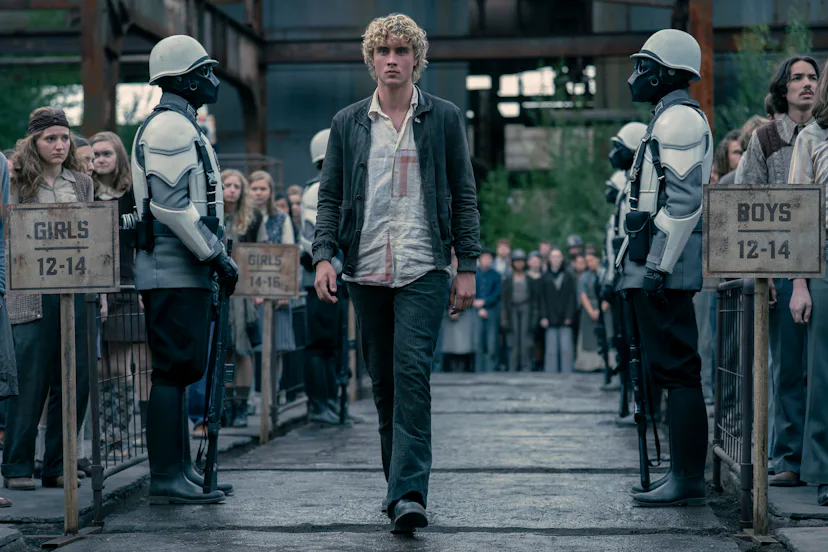
Elle Fanning was in her feels the second she tried on Effie Trinket’s clashing patterns. Jesse Plemons cared deeply about shoes the camera would never even see. That same level of obsession is woven into every stitch of The Hunger Games: Sunrise on the Reaping — out in theaters today, Nov. 20 — packing Haymitch Abernathy’s heartbreaking origin story with hidden lore and love letters to the OG films.
“Elle was very, very emotional. She was so happy,” costume designer Bina Daigeler tells Bustle, recalling the Oscar nominee’s first fitting as a young Effie. Honestly, fair. Fanning had some big heels to fill. Effie is one of the franchise’s most beloved characters, and the internet practically campaigned for the actor to land the part before murmurs of the movie adaptation were even in the works.
Suiting up helped put Fanning at ease about taking on the iconic role originated by Elizabeth Banks. “She was just thrilled because we knew we went in the right direction,” Daigeler says. “There were so many patterns and textures and mismatches of stuff that we just knew worked. It was so much fun. We tried all her costumes in the same first fitting.”

Mckenna Grace also had strong feelings about her character’s costumes. The 20-year-old actor, who plays District 12 tribute Maysilee Donner (and her twin sister, Merrilee), has mentioned petitioning for certain book details to be added to her wardrobe, including her braids and the beloved Mockingjay pin, which eventually gets passed down to Katniss Everdeen.
So reading into every costume detail — from young Effie’s butterflies to young Plutarch Heavensbee’s deceptively simple suits — is totally fair game. Ahead, Daigeler breaks down the meaning behind Lenore Dove’s wardrobe and the rock-star inspo for Haymitch’s “bad boy” moment, and even answers some of Reddit’s biggest costume questions.
Let’s start with the arena ’fits. In the books, the tributes wear pitch black (to hide blood), but you went with white bottoms and black tops. What drove that visual change?
We needed to show all the different district colors, and it was easier with white. Also, in dark moments, they stood out.

I’ve seen comments from fans on Reddit like, “We love that it’s white because you can see it getting dirty throughout the Games.”
Exactly. Sometimes you need freedom for your own interpretation. You can’t take the books exactly as they are because some things work when written, but they don’t work on screen.
Lenore Dove’s outfits feel very Covey-coded. What details did you weave into her wardrobe to connect this film to The Ballad of Songbirds & Snakes?
It’s this very bohemian, hippie look that shows her freedom, and that she’s a revolutionary, very inspirational, very kind, and strong. With her boots, she’s grounded, while her softer fabrics blow in the wind with her. The idea was inspired by the ’70s and Woodstock. It makes complete sense with her character and personality.
The red dress she wears at the reaping is also the red dress she dies in. What’s the symbolism behind that?
It’s important for how the audience remembers her — and for Haymitch, too — that you first see somebody so alive and so strong. And then that comes full circle.

Is there one huge Easter egg that you hid in a costume that fans haven’t clocked yet?
There were a lot of personal interpretations, like Drusilla’s pink feather. I just try to make it all make sense and have a thread that connects well with the other Hunger Games films. That’s super important to me. I also try to make everything attractive and appealing. Even when you take Snow and his cruelty, he still looks appealing — which makes him much more disturbing.
What was the most collaborative outfit with a cast member?
Most of them were. It was very fun to create Caesar Flickerman, Magno, Effie Trinket, Drusilla, and the showgirls.
With Jesse Plemons’ Plutarch, he’s a very serious and dramatic character who lives a double life and always has to hide something. That required psychological costume-making. Where do you break it up? Where is he dressed like the Capitol, and where is he dressed as himself, leaving you wondering, “What is he really doing? What is he trying to say and hide?”
To reflect that in his wardrobe, I did a deep dive with Jesse. For example, what kind of shoes does he wear? It’s something the audience might never see, but for him, it was super important. His costumes are very interesting — they look plain, but they’re not.

Then there was Haymitch’s bad-boy look. Was that inspired by a specific person?
It was inspired by all the iconic rock stars — a good leather jacket, boot-cut pants, and boots. When you make a hero movie, the look needs to be timeless. You should be able to look at it in 10 years, and the leather jacket will still work. You want the look to age well.
Magno sports a distinctive snakeskin jacket — and a literal snake at one point. What does his reptilian aesthetic say about his character?
That you can’t trust him. You never know what’s happening. Plus, he has those dangerous eyes, like he’s somehow poisoned.

Drusilla’s looks have a very Alexander McQueen feel. Were you nodding to the McQueen moments in the original Hunger Games, like Effie’s butterfly dress?
That is a nod, totally. McQueen is so amazing and such an icon, so we always draw from that.
Which single costume was the most expensive, took the longest to construct, or blew out the budget?
They were all very elaborate. Take Snow’s white suit — the entire lapel is hand-embroidered with roses, with little raised studs. That suit is so well tailored that it took nearly as many hours as Drusilla’s red dress.
One of Flickerman’s costumes was all Swarovski crystals. We had so much fun with his looks, it felt like we could never stop: “Oh, let’s put some more stones on here.” There’s so much just fantasy behind it.

This interview has been edited and condensed for clarity.
