28
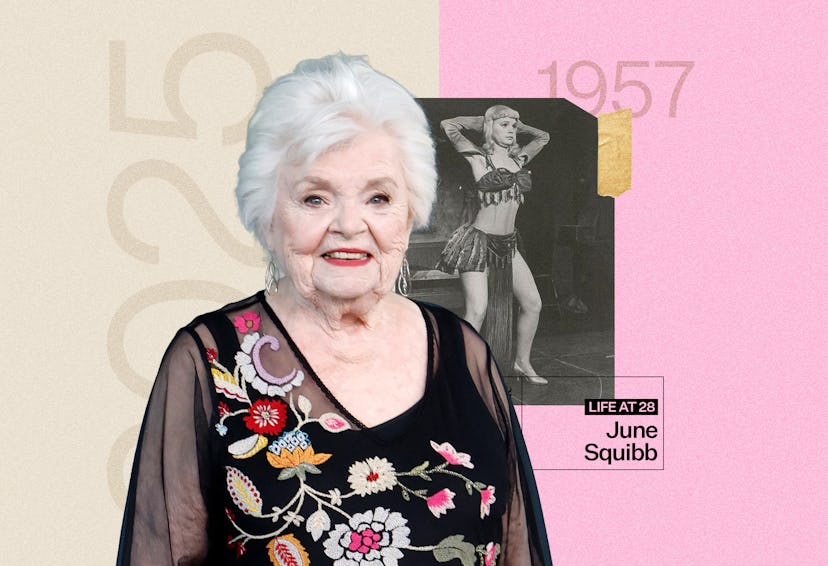
At 28, June Squibb Landed Her (First) Big Break
Nearly seven decades after her theatrical debut, the actor is wrapping up a star turn in Broadway’s critically acclaimed Marjorie Prime — and reflecting fondly on her early days in New York.
Ask just about anyone who works in a creative field about AI, and they’ll likely begin to squirm uncomfortably in their seat. June Squibb understands the hesitation — and insists we embrace it nonetheless.
“I think we’re all a little frightened of AI because we don’t really understand it all the time, nor do we understand exactly what it can or can’t do,” says the actor and star of Broadway’s Marjorie Prime, in which AI is a central theme. “There’s nothing you can do to stop it. And the only thing we can do is learn how to work best with it, learn how it can help us.”
With a career spanning seven decades across film, TV, and the stage — and no desire to stop — the 96-year-old actor has little reason to be afraid of anything. Squibb started out in the theater in the ’50s, first at the Cleveland Play House before moving to New York, where she got her big break in the off-Broadway show The Boy Friend and made her Broadway debut in the original production of Gypsy. TV and film work wouldn’t follow until years later — she landed her first movie role in 1990, in the Woody Allen romantic comedy Alice — and her mainstream breakthrough came in 2013 for her turn in Nebraska, which netted her multiple award nominations, including an Academy Award nod for Best Supporting Actress. Even her first starring roles on the silver screen — in the 2024 action-comedy Thelma and last year’s comedy-drama Eleanor the Great — were relatively recent career achievements. Then Marjorie Prime came calling.

“At the time we were just finishing up Eleanor… and I just wasn’t sure,” recalls Squibb, whose last stint on Broadway was in Waitress in 2018. “But I read the script and I thought, ‘Oh, my God, this is brilliant.’ So I said yes to it, and I’m awfully glad that I did.”
The Jordan Harrison play, which was nominated for the 2015 Pulitzer Prize for Drama, tackles aging, memory, grief, loss, and how AI plays a role in all of those issues — for better or for worse. The work was ahead of its time when it was written 12 years ago: It was hard to imagine then the sudden dominance AI and services like ChatGPT would have on our culture today.
In Marjorie Prime, which wraps its run at the Hayes Theater on Sunday, Squibb plays Marjorie, an aging woman with early dementia who chats with an AI hologram — a “prime” — of a younger version of her late husband, Walter (Christopher Lowell), in order to preserve her memories and grapple with his loss. At its core, the play explores the tensions of leaning heavily on AI for emotional support: The more details you feed the primes, the smarter and more realistic they become. Marjorie’s son-in-law, Jon (Danny Burstein) — who has a more positive outlook on the technology than his wife and Marjorie’s daughter, Tess (Cynthia Nixon) — helpfully pumps Walter Prime with stories to comfort Marjorie, but he and Tess must grapple with their own grief while navigating Marjorie’s ailing health.

“It's just very humbling, in a way, for me to have been with them,” Squibb says of her castmates’ star power.
Below, Squibb looks back on her arrival in New York, landing her big break, and what she was still learning about herself in her 20s.
You came to New York around age 27 and soon appeared in The Boy Friend off-Broadway. What was that like?
The Boy Friend was a big, big hit. We had done a summer tour of it, and then they opened it off-Broadway about three or four months after that, I think. Everybody in the city came to see The Boy Friend, and everybody knew all of us. I had people recognizing me off the street. That was the first time that ever happened — a big success, and I was a part of it. So that was very exciting. It was the first time I think a lot of people were aware of June Squibb, especially in New York.
The first time getting recognized on the street must have been a surreal feeling.
I couldn’t believe that someone actually knew who I was. I think I was walking on Fifth Avenue or something. Someone stopped me and said, “Oh, my God, I saw The Boy Friend, and you were wonderful.” How in the world did that happen? That’s all I could say. How did they know who I was?

How did you find a community in New York when you got there?
My husband and I had a wonderful old apartment in with a huge yard in the back. I would walk down to the theater every night. It was great. At that point, we had a lot of friends from Cleveland from the Play House, because a lot of us left Cleveland at the same time and came to New York. The people in The Boy Friend were who we spent time with. The wonderful woman who played Maisie is still a friend of mine — we still see each other.
What was your outlook on life at the time — what were you insecure about or intimidated by? What were you confident about or excited by?
I was scared of everything. Everything. I always knew acting was what I was going to spend my life doing. But there was a lot of learning in that period — I learned a lot from The Boy Friend. When I came to New York, I didn’t know that I was going to do a musical. And so my first 20 years were doing musicals. Those shows solidified the fact that I was a music performer, but I had to go out to regional theaters, and I did a lot off-off-Broadway, to prove that I was an actor — not just a musical performer.
In your 20s it’s easy to overthink things. Looking back, what made you realize, “Oh, I didn’t need to devote my energy to that.”
Every time I didn’t get a job, I was so upset because I didn’t get something. It was so important that I proved that I could do it — all of them.
Having done so much theater, TV, film, how has your relationship to ambition changed over the years?
As you get older, your physicality has been compromised. But I still want to continue to work. I still get excited when I read a script.

What kind of roles excite you the most these days?
I was terribly excited about both Thelma and Eleanor the Great. I have never forgotten doing Nebraska. Shooting it was a great experience, and then all the reaction to it. And I love Eleanor, because you saw so many facets of her personality. Nothing was forbidden in terms of Eleanor. You saw everything that an aging woman could be. So that’s what I look for.
Somebody asked me the other day about comedy and drama. If I’m in something that is considered a drama, I always look and see what kind of comedy it has in it, because I don’t think that a drama is to be completely without humor — I think that we have humor in our lives all the time. I look for things that are as real as can be — what can be as close to our lives as you can, honestly.
