The Entertainers Issue
Kristen Bell’s Happy Tears
As the third season of Nobody Wants This hits Netflix, the TV perennial, Frozen superstar, and modern-marriage poster girl reveals her secret sauce.
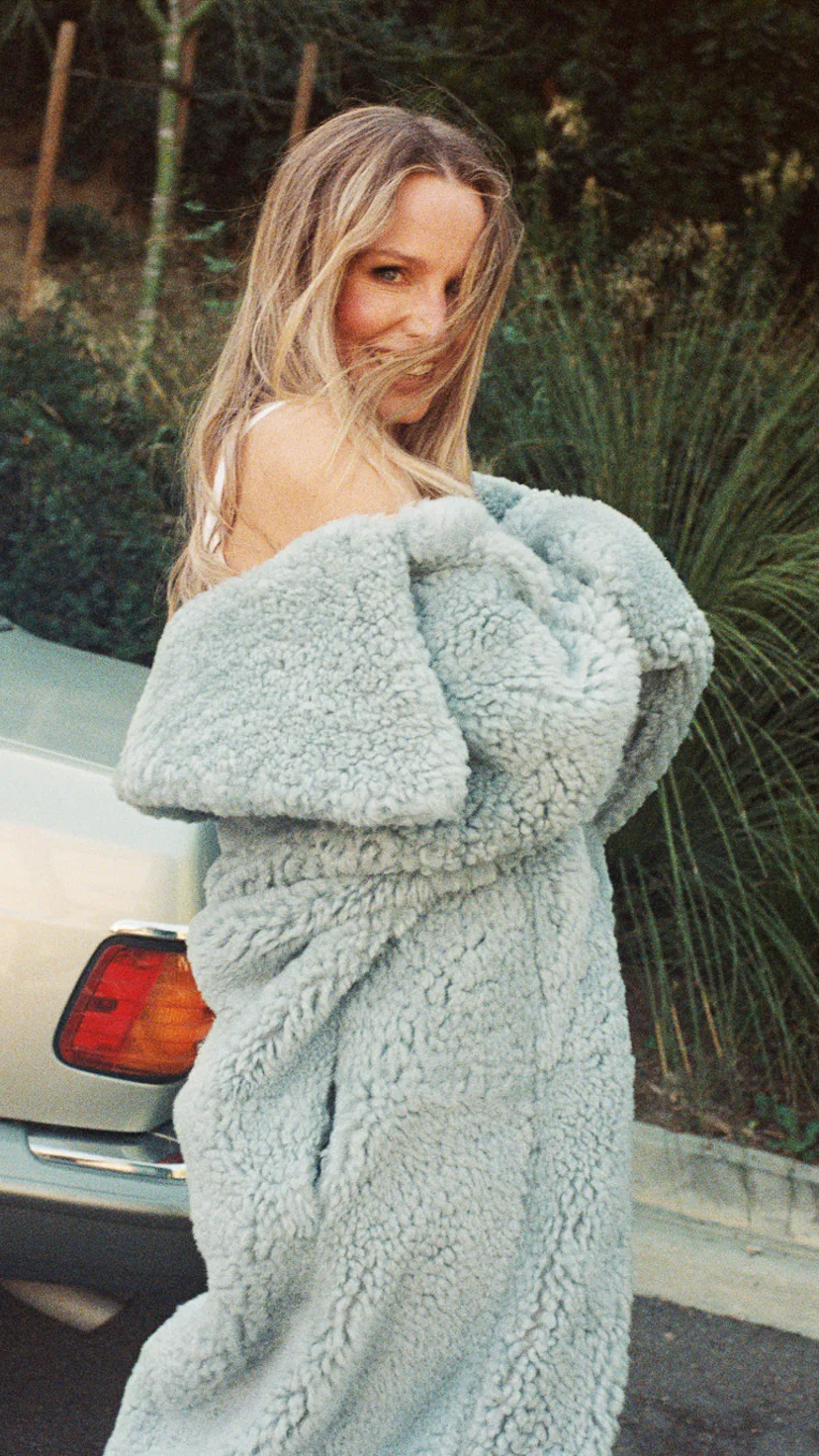
Kristen Bell appears on my computer screen eating a bowl of yogurt. She is backlit by a gauzy curtain in a corner of her California home, her blond hair in a top knot. She wears a black T-shirt and no visible makeup. She is 46, looks 16, and, almost immediately, is speaking with the wisdom of your coolest 76-year-old aunt.
“We all act like we’re not connected, but that’s the biggest joke. I see the world as a large family that f*cking fights a lot. I like that about myself, and I’m not planning on changing it no matter how much tribalism is presented to me,” she says. It’s a theme she returns to repeatedly in our conversation. “That’s what I love about Nobody Wants This. They’ve learned not just how to love, but how to fight and how to forgive and how to choose each other despite differences. I think that’s something the world could use more of.”

Bell speaks with her hands, fluttering and fanning her tapered pink nails, and expertly deploys eye contact — she’s not taking her eyes off of you, so you can’t take your eyes off of her. “I’m a feeler,” she says, her eyes welling up. “I wish I wasn’t sometimes. But I also know it leads me to a lot of my creative process. And I think creativity is one of the most important things in the world.” She sees her gifts — her ability to communicate emotion, her crystalline singing voice — as almost a moral imperative to improve the lives of those around her. “I do think thoroughly about how, hopefully, [a project] will land,” she says. “I could be in [viewers’] living room at night after they’ve had a hard day, and when they sit down, I could sweep them away into a world that is only imaginary, and for one hour, they forget that their hands and feet hurt.”
The third season of Nobody Wants This, Bell’s hit Netflix comedy, drops Oct. 22. The show, about agnostic, devil-may-care sex podcaster Joanne (Bell) falling in love with a careful, tradition-loving rabbi, Noah (Adam Brody), and the chaos it causes in each of their lives, is rom-com light. But it debuted in 2024 amid heightened antisemitism in the wake of the Oct. 7 attacks in Israel and the war in Gaza. Initially, the show was knocked by some for stereotypical portrayals of Jewish women — but it ended up being a huge win for Netflix, drawing 57 million viewers in its first three months on the platform. And as Joanne and Noah’s love story has developed, the series has blossomed into a surprisingly sweet treatise on tolerance, resilience, and the beauty of Jewish ritual and spirituality.

“Having people be disappointed in me is really hard for me. Like really hard. And with raising kids, that’s like a whole other level.”
Bell has made a career of making you root for other headlong women, rushing into danger (Veronica Mars), into the arms of oversexed rockers (Forgetting Sarah Marshall), into ice storms (Frozen), and into the afterlife (The Good Place). Though there are some Extremely Online People who don’t always manage to connect with Bell’s sense of humor on social media — the brouhaha about her tongue-in-cheek Instagram post to Dax Shepard on her last wedding anniversary comes to mind — she radiates likability even when she’s playing a next-level bitch (see her recurring guest roles in Party Down and Parks and Recreation). As Bell’s husband of 13 years, podcaster and comedian Shepard recently put it, “How on Earth could you hate this woman? She’s so lovely. If you hate this woman, clearly you’re bonkers.”
It’s true that in our stressed-out, maxed-out, polarized, atomized, rage-baited era, Bell is like a half-pint of lemonade: a sweet-tart all-American crowd-pleaser, able to take down the temperature and brighten the spirits of any room. Now that Dolly Parton and Betty White are no longer with us, Bell is probably in the running to take over their roles as America’s Most Beloved. But, as with Parton and White, what is sometimes missed thanks to Bell’s Labubu level of cuteness and killer comedic timing is the weapons-grade intelligence ticking away behind every performance. “People know she’s funny. But I don’t think anyone fully, fully grasps how wicked smart she is,” says Monica Padman, Bell’s longtime business and producing partner and co-host of the podcast Armchair Expert with Shepard. “She’s very quick and witty. Because she has all these other beautiful and shocking qualities … [that] does not really get mentioned.”
Bell has frequently claimed to have no big plan, no ambition for world domination, and yet, let’s face it: With her hit show, three upcoming movies (Violent Night 2, Sonic the Hedgehog 4, and Frozen 3), and a new role as a L'Oréal Paris spokeswoman, she’s dominating. “I’m a busybody. I like doing. I like creating. I like new experiences,” she says. “It’s hard for me to state my goals because my narrative tells me I don’t have them. Perhaps that’s because I would feel too arrogant. My goal is to be happy with the next decision. I go based on my gut. I have very strong gut feelings. Obviously, I wanted to create a life for myself and put food on the table, which is why I wasn’t doing plays in my backyard for free my whole life.”

Community theater in her native Detroit is where Bell caught the acting bug, playing a banana in a play about Raggedy Ann. “My mom had heard me singing all the time around the house,” she says, and took her for voice lessons and to an audition. Though Bell did ultimately get an agent and snag a few professional gigs before heading to New York University’s prestigious Tisch School of the Arts, she’s glad she grew up in the theater and not on set. (She has one pre-college major movie credit, as an extra in Claire Danes’ 1998 Polish Wedding.) “In theater, there is no craft service. There are no PAs. There is no driver. You show up on time or you’re fired, whether you’re the lead or in the chorus. You go sit in your moldy dressing room until your cue is ready, and you better be on stage. There’s more of a collective energy.”
Bell immediately connected with the tolerance in the theater community. “It was a group of people who were a bit weirder than the norm, just like I was. Everything was accepted. You could choose to wear something insane — a huge striped top hat — and you might feel nervous in the grocery store. Is anyone looking at me? You walk into a theater, and they’re like, ‘Oh, baby queen, gorgeous, I love it. Where did you get it? Can I try it?’ There’s such an effusive sense of celebrating everything.”
“I’m a little bit Veronica Mars, a little bit Sarah Marshall. I’m a tiny bit Joanne. But I’m the most like Anna [from Frozen].”
Bell dropped out of Tisch her senior year, in 2001, when she won the part of Becky in a Broadway production of The Adventures of Tom Sawyer. Soon she was scoring guest parts in TV series. Her big break came in 2004 with the titular role in Veronica Mars. She was the first person who auditioned with creator Rob Thomas, who says he saw 100 more actors before realizing Bell had nailed it in that first meeting. Bell went on to dazzle everyone involved with her flawless takes and ability to handle everything from screwball comedy to her character’s devastating rape. She earned the nickname “Money” because of her dependability in every take. Thomas told directors that if they ever had a difference of opinion about a creative choice with Bell, Bell was always right. “She had so much control. So much control,” Thomas says. “When you’re doing the CW shows that I was doing, you’re working with young actors. You see a lot of bad acting. But Kristen was like clockwork, just, like, done.”


Shepard, whom Bell met through mutual friends in 2007, wanders into the room as she is telling the story of their early romance. He was initially attracted to her passion for Bed Bath & Beyond coupons — as a fellow Michigander, he found her thriftiness familiar and hot. “I definitely stole those from my neighbor’s mailbox back in the day. And I’ll say that on the stand,” she says.
But he really fell for her during a game of “running charades” Bell organized at her house. Running charades, for the uninitiated, involves sprinting back and forth for clues before acting them out under a time pressure. Bell tells me she would gather 30 people, “theater folk. We played it full contact. You were allowed to move furniture as an obstacle. You were allowed to push an old dog into a hallway that someone could maybe trip [over]. You were allowed to hip check people.” The one thing Bell would not allow was folding up the clues — too much of a time waster to unfold. Bell had climbed onto her kitchen counter to give a “very harsh speech that if you fold your paper, you will no longer be invited back. I’m done with people folding their paper. This is a time game. If you do it, you’re out.”
She turns to Dax and says, “And then you said later on — right? — you thought that was very attractive.”
“I knew there was trouble ahead,” Shepard calls out from off camera. He describes it as the moment he realized she was “a boss, a force of nature to be reckoned with. I said, ‘Look at this little powerful [person].’”
Over the years, his instinct has been confirmed — “She’s not afraid of the gorilla she lives with,” Shepard jokes. The two got engaged in 2010 but postponed the wedding until after California legalized same-sex marriage. They finally tied the knot — after Bell re-proposed on Twitter and Shepard accepted — in 2013, after the birth of their eldest daughter, Lincoln (now 13). Their second daughter, Delta (now 11), followed in 2014.

Bell describes Lincoln and Delta as the primary factors in her decisions about which projects she accepts. “Is this going to pull me away from my kids too much? Will I still be able to be the mom that I want to be? That’s really the No. 1, to be honest. There’s nothing higher than that,” she says. “I would easily let my whole career and all its legacy and notoriety ‘disapparate’ tomorrow if it meant sacrificing something major in my kids’ lives, or not being there.”
This sounds like it could be a cliché celebrity homily to the sanctity of motherhood: Many mothers who don’t have to worry about their every word being picked apart online will admit that sometimes they wish their job and their kids would “disapparate” simultaneously, at least long enough to take a bath. But Padman says it’s true on an existential level for Bell. “She is a mom first. She is meant to be a mother. She moms outside of just her children, too,” Padman says. “She’s just such a maternal figure in so many people’s lives. People go to her for advice and nurturing. She oozes a maternal quality and she’s very willing to meet that across the board: with her kids, with adult friends, with other people’s children. She’s an open source of that.”
“I am not ashamed to admit I love my algorithm. You know what I did? I crafted it. I don’t pause on negative stories. I don’t pause on clickbait. I don’t pause on train wrecks.”


Which is not to say that Bell is some Pollyanna, twirling through her perfect life. Shepard and Bell have been admirably open about the challenges of marriage and family life. “It’s hard. Do not think because I am on your television that it is easy for me. It’s brutal. I cry weekly,” she says, citing Dr. Becky and Lisa Damour, Ph.D., as expert sources she regularly turns to for guidance. She says she wants to be honest about the strains of family life to make people feel seen. “Oftentimes when you’re in that cyclone of puberty, you could think, My kid is the only one doing this. And that is just simply not a fact.”
But Bell says that openness has become trickier to navigate as her girls have gotten older. “It’s always a debate between Kantianism and utilitarianism,” she says — yes, as in the 18th century German philosopher Immanuel Kant. “For the good of the people, we should share our dirty stories, we should share our shame, we should share our hardships. But for the good of the one? My main job in life is to protect those two. I guess a conclusion we came to at a time in our parenting journey is, like, we can share all the cute things when they’re little, but when they could possibly be exposed to [media] or possibly have a feeling in response to it … well, now, the equation has changed. There’s someone else in the mix, and you have to have enough self-awareness and consideration to consider that person. And that person is my daughter, so she’s No. 1.”

“Do not think because I am on your television that it is easy for me. It’s brutal. I cry weekly.”
The level of thoughtfulness Bell applies to, well, everything she does, does not come without a cost. Over the years, she has shared the work she does to stay on top of clinical depression and anxiety, starting from when she was in college. She wrote an op-ed for Time magazine, made a video for the Child Mind Institute, and was a mental health spokesperson for the telehealth company Hers. She’s advocated for therapy and destigmatizing medication and spoken about her success with eye movement desensitization and reprocessing (EMDR) therapy.
Most recently, she has been touting her work with neuropsychologist Julia DiGangi, Ph.D. “She is a knife through the noise,” Bell says, confessing that she found her while scrolling online. “I am not ashamed to admit I love my algorithm. You know what I did? I crafted it. I took very seriously when [author] Yuval Harari told us to pay attention to what you consume, not just your food. I don’t pause on negative stories. I don’t pause on clickbait. I don’t pause on train wrecks. I keep informed, but when I’m participating in social media, it’s dogs doing funny stuff. It’s knitting. It’s crafts. It’s tiny tidbits that help you get through your day. She popped up.”


She did an online course with DiGangi “to soothe my anxiety” and started seeing “the biggest difference in my life than I have with almost anything I’ve applied.” Soon she was reaching out to DiGangi for individual coaching. “I still struggle with [anxiety] every day. It’s not anything that’s gone away. I think it takes a long time to change your neural pathways from habits you’ve created. Your brain is a pattern detector. That’s the main thing she talks about, and it’s so true. But if I can change my patterns, maybe I can change the amount of anxiety in my body.”
Lately, Bell has been examining her pattern of people-pleasing. On a podcast with psychologist Adam Grant, she blew this reporter’s mind when she said, “I’m accepting the fact that over-explaining is a form of begging.” Juggling the roles of mother, wife, friend, daughter, actor, celebrity, and involved citizen would seem to offer an almost impossible bind for Bell — one that is familiar to many women of her generation. You can’t say yes to everything; you want to show up for every part of your life; time and energy are finite; saying no means disappointing someone.

It is clear as Bell speaks that she compounds the problem by holding herself to exceptionally high standards. “I do things I love and care about... So oftentimes I will work myself to the bone or work till I’m exhausted because I genuinely care about how it lands in the world,” she tells me at one point. And, “Being considered arrogant makes me feel sick because I believe that no person is worth more than another.” She repeatedly checks in with me over the course of our call, hoping I’m getting what I need for this story and apologizes for getting “so philosophical so quick.” She says that “having people be disappointed in me is really hard for me. Like really hard. And you know with raising kids, that’s like a whole other level.”
When we commiserate about the unstoppable detritus and waste of raising growing kids, she admits that thinking so much about every plastic bag and candy bar wrapper that enters her home is exhausting. “My cognitive labor, much like yours, is an absolute burnout. It is always burnt out.” (Bell tip that turns out to be pretty helpful: She recommends the company Ridwell, which takes away otherwise hard-to-recycle items.)
“I’m a busybody. I like doing. I like creating. I like new experiences. It’s hard for me to state my goals because my narrative tells me I don’t have them. My goal is to be happy with the next decision.”


So the question (asking for a friend) is: If she’s no longer overfunctioning and people-pleasing — is she pissing people off? “It’s not causing difficulty. It’s causing a reckoning of my interiority,” she says. “It’s causing me to recognize when my people-pleasing is out of fear, which is about 50% of the time … and when it’s coming out of a genuine commitment to the health and happiness of my stewardship to the world around me. And just the enlightenment that it’s a choice reduces my fear by quite a bit.”
When you’re watching Bell play Joanne from Nobody Wants This, it can feel hard to square Bell’s meticulous caretaking with that more libertine character. Bell’s acting has a quality of being so natural as to seem like she’s always being herself on screen. “I almost never see performances that match her natural tone,” says Padman. “When you know her very well, you’re watching her play all these roles ... and you’re like, ‘Oh, she’s acting, because that’s not her at all.’”
Toward the end of our interview, Bell picks up her computer. “Sorry,” she says. “I’m going outside to get my little dose of sunshine today.” She arranges herself on a lounge chair and tips her head toward the sun as she considers what parts of herself she brings to each role. In sunshine, you can see a delicate earring glinting in her helix. There are a stack of life-size Halloween skeletons on the patio behind her chair, all face-down, like they’re trying to hide from the Zoom camera. “I’m a little bit Veronica Mars, a little bit Sarah Marshall. I’m a tiny bit Joanne,” she says. “But I’m the most like Anna [of Arendelle].”

“Oftentimes I will work myself to the bone or work till I’m exhausted because I genuinely care about how it lands in the world.”
Bell says the process of crafting the Frozen characters with Disney was the most collaborative project she’s ever been a part of. They worked through multiple iterations of the script, using improv and making character tweaks. “They were very open to each and every suggestion I had that rounded her out to be someone that I needed to see when I was a little girl. I needed to see a princess that did not have good posture,” Bell says. “I wanted that out there for the girls who felt a little quirkier, to see some representation.” Anna drooling while sleeping, her clumsiness — those are Bell’s input. She remembers telling writers, “I need her to talk too fast and wear her heart on her sleeve and just try because she wants to, because she cares.”
Some parts of the Frozen story were out of her control — “The Snow Monster will come when the Snow Monster will come,” she says — but as she’s explaining how she and her colleagues were able to influence how their characters reacted and “put words in [their] mouths,” Bell becomes visibly emotional. “It’s been one of the joys of my whole life that,” she says, pausing, her voice rising and growing thinner, “that project has been loved and accepted as it has been because I felt like I was very revealing in it.”
Her emotion is contagious. I tell her that Frozen came out shortly after I gave birth to my second daughter, and how, as a woman without a sister, I was so moved by the film’s ending that I could not stop crying, mostly with joy that my girls would know the sisterhood I had always longed for. “I love that. We are all connected. You may not have a sister,” she tells me, fixing me with her empathetic gaze, “but you can choose anyone to be your sister.” It’s an idea — along with a renewed commitment to recycle my candy wrappers and fix my Instagram algorithm — that stays with me.
Top image credit: Ulla Johnson coat.
Photographer: Matthew Sprout
Stylist: Ashley Furnival
Writer: Rachael Combe
Editor-in-Chief: Charlotte Owen
Editorial Director: Christina Amoroso
Creative Director: Karen Hibbert
Hair: Dimitris Giannetos
Makeup: Courtney Hart
Manicurist: Queenie Nguyen
Video: Kristina Grosspietsch, Tiki
Photo Director: Jackie Ladner
Production: Danielle Smit, Kiara Brown, Aubree Lennon
Fashion Market Director: Jennifer Yee
Fashion: Stephanie Sanchez, Ashirah Curry, Noelia Rojas-West
Features Director: Nolan Feeney
Social Director: Charlie Mock
Talent Bookings: Special Projects
