Theater
Mfoniso Udofia Is Rethinking What It Means To Create
The playwright’s new Lincoln Center Theater production, creation stories and all the important importants, explores IVF, ambition, and learning to dream differently.
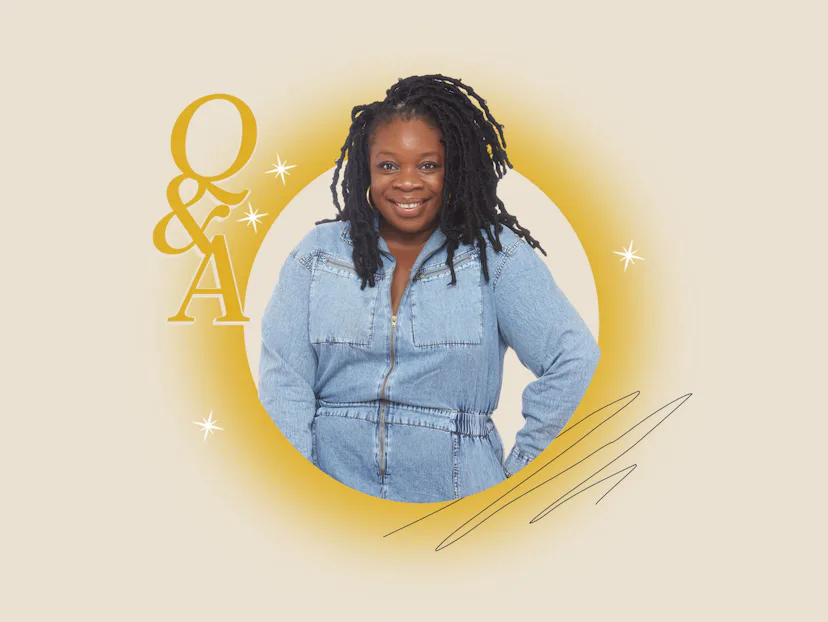
Once upon a time, like many young girls, Mfoniso Udofia loved fairy tales — reading and writing stories of princesses and castles. Now, as a prolific writer for stage and screen, Udofia has crafted one of her own: a story that’s deeply personal but also encompasses nothing short of creation itself.
What began with the idea of writing a fairy tale for a Black woman evolved into creation stories and all the important importants, Udofia’s ambitious new play asking big questions about fertility, creativity, and what happens when life doesn’t go as planned.
The story centers on a Black woman in midlife (Abigail Onwunali) — known in the play as thegrownwoman — navigating creation in many forms, from undergoing IVF to writing and teaching to helping her own mother. While juggling these stresses of everyday life, the play also enters a more fantastical plane, as thegrownwoman interacts with her childhood self (Savannah Commodore) and her imaginary friend, a horse named Mr. Cornell (Donnetta Lavinia Grays).
Udofia (also known for her nine-play Ufot Family Cycle and writing on TV series like Lessons in Chemistry, A League of Their Own, and Pachinko), began writing the piece while undergoing IVF herself, drawing on her experiences and Nigerian culture to tell a story that probes the pressures women feel to be exceptional — and what gets pushed down or sacrificed in pursuit of it. With creation stories now running though Nov. 11 at New York’s Lincoln Center Theater, Udofia spoke with Bustle about turning personal experiences into theater, what theatergoers are sharing about their own IVF journeys, and grieving dreams while imagining new ones.

How did the scope of the play change as you were creating it?
I kept looking at the fragments that I was writing and not understanding them, but also there was something in me that was like, “I don’t know about throwing this all away. I think it is important.” I also hadn’t seen too many plays about what it means to be in the throes of an IVF cycle as a woman, and to be at that particular age and think, “My career is starting to look solid, but is my personal life looking as solid as I want?” So the way it changed was I went from thinking that I was going to be writing outside in, to writing inside out.
Did writing the play make you reflect on your own experiences differently?
It did. I asked myself, “What is this obsession with productivity? What is this currency I’ve attached to my life and my world? And what happens if I let that go? Am I useless?” It was like I was writing to articulate those feelings, and then using that writing to understand if I still wanted to hold on to them.

You weave together different kinds of creation: the creation of life, creativity in writing, the creation of the universe, the creativity of children. How do you see all of those things overlapping?
In every way, we’re finding this woman outside of her ability to produce. And when your body can’t create, it feels like you can’t create anywhere else — or at least that’s how it felt for me. I wanted to touch on a woman who understood that if she put her will to something, she might be able to manifest it. I wanted to hold all of those creations, watch her fail at that, and then synthesize her with her younger self to create anew after values that were deemed useless, like sleeping or play, are brought back into the fold.
The way that technology is incorporated into the play is very interesting. I’d love to hear why you chose to show thegrownwoman speaking with Alexa and Siri.
The same actor plays both Mr. Cornell and Alexa. And when I was sitting and talking with Tamilla Woodward, the director, about this, it’s like the little girl has gone from talking to her horse to talking to her Alexa. The little girl is talking to a make-believe entity that pushes her to think expansively, to play daringly, whereas Alexa will just give you the most right answer for the moment, or so you think. It’s the replacement imaginary friend, a scheduling god. So both of them, grown woman and little girl, spent most of their time talking to something imaginary, and the audience can decide which imaginary being has more value.

Are women coming up to you and sharing their own IVF experiences after seeing the show?
My DMs are flooded. Women are finding me crying, some of them just going, “It was nice to see what my day looked like.” And that is fuel for me, because it’s just not talked about enough. So I’m feeling it from women, but I’m also getting some men who are like, “This is what it felt like for the person I love.”
There was one beautiful conversation I had along the lines of, “It might not be papers coming from the sky for me, but I wonder what I’m going to find if this last cycle doesn’t yield the thing I want.” And that is, I think, a beautiful takeaway — and it’s a hard takeaway, because you’re actively grieving the dream you do have, living alongside the things you can maybe also dream of.
This interview has been edited and condensed for clarity.
