Entertainment
Uma Everlasting
The Dexter: Resurrection star has always sliced her own path through Hollywood (even if she’s secretly a softie). Now, with her kids mostly grown and a slate full of big-swing roles, she’s going “full throttle.”
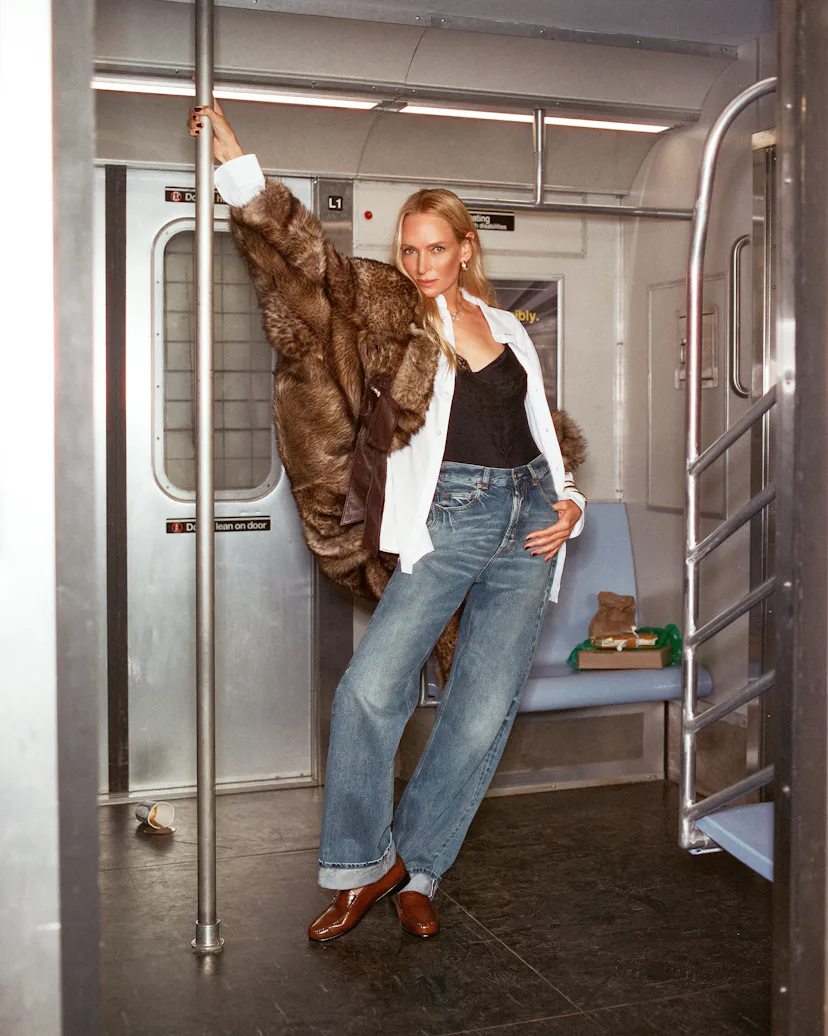
Uma Thurman was still a young child when she became fixated on the idea that she needed to formulate a life plan. The daughter of a Buddhist scholar and a former model turned psychotherapist, she grew up in a household where the intellectual stakes were high, and an independent streak was encouraged. “Both my parents were and are, in their own ways, very remarkable… unique, self-created individuals,” she says.
“I just had a sense that I was going to be providing for myself, and that there was no net,” Thurman says, with a shrug. “You know how kids get a bug in their head? I got a bug in my head. Like, ‘Oh, this isn’t going to last forever. I’ll make a move. I’ll do something.’”
Within three minutes of logging into our Zoom call, it is clear that Thurman is not one to linger on the surface of things. Sitting in her home office in Manhattan surrounded by framed black and white images, silver tchotchkes, and bookshelves that look like they’re actually in use, she is fresh from a shower, with combed-back wet hair and skin that looks fresh-scrubbed, save lingering traces of black eyeliner. As she talks, she gestures with her famously attenuated hands, revealing nails that are cut short and varnished a color that — even if it wasn’t being worn by Uma Thurman herself — many of us still think of as a Mia Wallace-esque noir.

At 56, the mother of three (her youngest is a high school freshman, while 24-year-old Levon and 28-year-old Maya Hawke are actors in their own right) has a slight gravelly edge to her once-flutelike voice, and an earned wisdom to her gaze. Otherwise, though, Thurman appears to be aging exactly the way one might expect from a bona fide movie star with her genetic advantages. Which is to say barely at all.
It’s hard not to feel a little starstruck by her presence, even when, technically, you’re only looking at her face, with its instantly recognizable features, on a computer screen. “There’s nobody who doesn’t know who she is,” says Clyde Phillips, the veteran TV creator behind the original Dexter and its reboot, currently featuring Thurman in her latest role, that of an ice-cold henchwoman in Season 2 of Dexter: Resurrection. “She’s iconic.”
On the show’s set, Thurman’s icon power took some getting used to. Dexter himself, Michael C. Hall — a TV icon in his own right — recalls comparing notes with Season 1 co-star Krysten Ritter “about our struggle to get over the fact that Uma Thurman was there.” Even Phillips, who recruited her to the show and, after two seasons working together now considers Thurman a good buddy, says he still has to pinch himself on occasion. At a large, complicated shoot in Times Square earlier this year, he remembers people “walking by going, ‘Holy sh*t, that’s Uma Thurman!’” He understands the feeling. “I was at her birthday party, and I’m thinking, ‘Holy sh*t! I’m in Uma Thurman’s house.’”

“I was missing in action with focus on the home front for the last 28 years. Now, my children are still in first position, but they can share the stage a little.”
Regarding that grand childhood plan of hers: Thurman’s father, Robert Thurman, who died at age 84 in June this year, was a Harvard Phd who became a professor at Amherst College in leafy western Massachusetts, where Thurman and her three brothers largely grew up. He went on to found the Tibet House — an organization dedicated to preserving Tibetan culture — alongside Richard Gere and Philip Glass. Suffice it to say that the family as a whole was academic, progressive, formidable. “Everybody was brilliant and getting, like, perfect SAT scores,” she says.
Thurman didn’t feel brilliant. It wasn’t until well into motherhood, when she was filling out a form about her own educational development in service of one of her kids, that she realized she hadn’t been able to read “a book with more words than pictures” until fourth grade. It was “a funny light bulb,” she says. “I was absolutely dyslexic.” Eventually, she says, “a dyslexic will crack the code, and years later, missing foundational pieces, they will read,” she says. Today, she loves reading. But she still experiences dysgraphia (the transposition of letters) and has difficulty with spelling and grammar. “It chases you all the way.”
As a kid, this left her frustrated and confused. She was obviously intelligent. “I could understand everything,” she says, “until you took the sound away, or the visual cue.” This left her with an “early feeling of being stupid.” That’s the kind of idea that leaves a mark. Convinced that she “couldn’t shine academically,” she knew that her big plan, whatever it may be, was going to have to be something totally different from her family background.

At 15, she left her Massachusetts boarding school on her own for New York City, where she moved into a studio apartment and started modeling. (This wasn’t as controversial on the home front as you might imagine, since it was something of a family tradition: Thurman’s mother had left home at 16 to pursue her own modeling career.) Modeling was not the grand plan: It was always intended to be a brief stepping stone to acting, and that’s what it became.
By the time her high school classmates were packing up their lava lamps for college, Thurman was playing Cécile, the porcelain-skinned virgin deflowered — and seriously turned on — by a scheming John Malkovich in Dangerous Liaisons. At 20, she played the wife of Henry Miller and the lover of his lover, Anaïs Nin, steaming up 1930s Paris in Henry & June, a movie that made history as the first ever to receive an NC-17 rating.
From the jump, Thurman displayed both a stunning willingness to go there and an innate onscreen magnetism that went beyond her unusual looks — the deep-spaced Bambi eyes and lit-from-within golden coloring. No matter the role, the co-star, or the genre, when Thurman is onscreen, it’s hard to look at anything else. For Hall, this je ne sais quoi is Thurman’s ability to “achieve dynamic movement in the middle of absolute stillness,” he says. “Where there’s nothing demonstrably happening, and yet so much seems to be going on.”
Imagine a light bulb, Hall continues: “Even though its light seems kind of static, there’s a lot going on to make it shine. She’s just got that thing.”


“I wasn’t looking to Xerox an archetypal woman for people. I wanted to be an actor who explored different things.”
She was just 23 when she joined forces with the creative partner of a lifetime, Quentin Tarantino, in the role of a lifetime. As Pulp Fiction’s aforementioned dark-fingernailed heroine, she drank milkshakes and did the twist, cool as a cucumber opposite John Travolta, a movie veteran who had made his name sliding across light-up dance floors. This past August, Mia Wallace’s white button-down shirt and black flares — the simplest, chicest costume ever to make it into the Halloween hall of fame — sold at auction for $64,000, more than twice its estimated pre-auction value.
Tarantino worked for a decade on the follow-up, centered on a character they created together. As The Bride, she swashbuckled her way through Kill Bill Vol.1 and 2. If Pulp Fiction made her a movie star, Kill Bill cemented her legacy, making her the female action hero of a generation. Years later, her cinematic descendant, Charlize Theron — equally tall, equally golden, equally badass — would tell Jimmy Kimmel that Thurman was the “OG” of the genre — the “sensei.”
Kimmel eagerly agreed: “She should have won the Academy Award for Kill Bill, right?”
Theron’s reply: “A hundred percent. Men get a lot of credit for these movies.”
What Uma Thurman did to prepare for Kill Bill was herculean in a way that, like so much of her early work, hits different circa 2026. Not only did she train for months to swing katanas, shoot guns, and perform three different styles of martial arts — she did it all starting when her son, Levon, was just 8 weeks old.

Thurman trained with “a master who you actually called master,” she recalls. The first time she walked into the training gym, infant son in one arm, his team stared at “this out-of-shape mother standing in front of them,” she says. “They had this kind of oh-my-God reaction — like, we have to work to work with that?” Among action-movie heads, the film’s biggest fight scene is canon. In the long, bloody sword battle sequence known as the “Crazy 88,” Thurman single handedly eviscerated an army of at least 40 stuntmen. All while taking breaks to breastfeed. (When I marvel at this physical feat — how did she do that? — she demurs. Tarantino, after all, had created the movie around her and then timed the shoot around her pregnancy — of course she was going to do whatever it took to live up to the role. And besides, “People are nursing in flooding tents. Is what I did anything special? No.”)
Given all that, it may surprise you to learn that Thurman is secretly a bit of a softie. More than anything, she says, she loves romantic comedies. She’s read all of Nora Ephron’s books, and when she discovered that Ephron recorded the audio for a lot of them, she listened to them, too. “I’m sad that I’ve already listened to them, and I don’t have them to look forward to,” she says. “I know this makes me seem very corny and sentimental.”
There are few true romantic comedies on Thurman’s resume. One is 2005’s underrated Prime, in which she plays the “older” love interest of the son of her own therapist (played by Meryl Streep). Then there’s 1996’s The Truth About Cats & Dogs, in which she plays the obstacle, not the lead: In a Cyrano-esque spin, she’s the Helen of Troy who turns Ben Chaplin’s head away from “regular woman” Janeane Garofalo. Thurman is matter of fact about why she wasn’t cast in more rom-coms: At 5-foot-11, she did not fit the mold. “Leading ladies couldn’t be taller than leading men. You would not be considered, bottom line.” (She’s too polite to specify which projects she lost out on because of stature.)
There was an upside to not being, as she puts it, “a typeable type.” It forced her to become versatile, which ultimately defined her career. “Also, I wasn’t looking to Xerox an archetypal woman for people,” she says. “I wanted to be an actor who explored different things.” If her resume runs the gamut — from art house films to popcorn movies to serious theater, action to drama and back again — she says that’s very much by design.


Last year, no one knew whether Dexter, the serial killer drama that refuses to die, could or should be revived. The original show ended in 2013 after eight seasons; since then, the franchise has given us a prequel (Dexter: Original Sin) and a sequel (Dexter: New Blood). Still, Hall thought his “killer with a conscience” had work left to do. And Showtime, for which Dexter: New Blood had turned out to be the most-watched show in the network’s history, was ready to roll the dice.
To up the ante, Phillips and longtime co-writer Scott Reynolds assembled a murderer’s row of co-stars, including the aforementioned Ritter, plus Neil Patrick Harris, Eric Stonestreet, and Peter Dinklage. The latter played a twisted billionaire tech wizard (timely) whose dirty secret is a basement museum in which he stores his passion project: collecting the gory “trophies” of noted serial killers.
Phillips says that in addition to trying to keep Dexter dangerous, funny, and vulnerable, he always wants to keep its audience “leaning forward,” which meant bringing a certain icon into the fold. Over Zoom, he demonstrates, bringing his face 2 inches closer to the screen, as if to get a better look. “When I see Uma Thurman in a television show, I go like this. I lean forward. I pay attention.”

The definitional quality of Dexter Morgan is that he’s a serial killer who is not a lunatic — he operates by a strict code, plying his craft, so to speak, only on evildoers he thinks deserve to die. He’s the Robin Hood of serial killers. Which doesn’t mean he doesn’t relish the job.
As Hall puts it, Thurman naturally “presided over” every scene as Charlotte “Charley” Brown, a character who was introduced last season as the terrifyingly composed body woman of Dinklage’s billionaire. She’s a decorated former Ranger in the U.S. Army with a law degree from Harvard and, in Season 1 at least, a ruthlessly sleek blond bob. (Phillips and Reynolds are diehard Tarantino fans, but it was total coincidence that the show’s costume designer happens to be Cat Thomas, the same person who came up with The Bride’s indelible yellow tracksuit.) As Thurman sees it, Charley is “a highly trained professional warrior” who has “done bad in service of her country,” and then, in retirement, found herself in the unfortunate position of being the right-hand woman of a raging psycho — who happens to be paying top dollar for her invalid mother’s medical care. (Talk about golden handcuffs.)
“Charley’s job turned into this toxic, dark, sick thing that she’s locked into by financial need,” Thurman says. “And she hates herself for it.” But like Dexter, she also seems to take a certain job satisfaction in, say, deftly bludgeoning a guy with a nail-studded baseball bat, just because he touched her shoulder.
It’s delicious to watch Charley doing dirty work of her own while maintaining a withering disdain for the bloodthirsty killers in her midst — exhibiting a glamorous chill that even Dexter can’t resist. “In spite of himself, Dexter is captivated by her,” says Hall. “That’s not something I had to manufacture. I just sort of… rest in the tractor beam.”
“People who are obsessed with ‘work-life’ balance — no thanks. I want to be fulfilled in action, and I want to be comfortable at rest.”
Online, the only audible complaint about Thurman’s performance in Season 1 was that there wasn’t enough of it. The part was mostly written by the time Thurman signed on, and while Phillips was able to work a little more backstory into the part once she was on board — close viewers might even catch a nod to her hometown of Amherst — for Thurman fans, it was a bit of tease: Why hire Uma if you’re only going to give her a few minutes of screen time per episode?
Thurman, too, had doubts initially about whether there would be enough for her to do in Season 1. The whole season’s worth of scripts were largely stitched up by the time she read them, which Phillips says is part of his strategy: In the hiring process, it is much easier to sign legends like John Lithgow on to your serial killer project if they know “exactly where their character is going, and that we’re not going to f*ck them over in the end.” Thurman says being able to see the whole arc of Season 1 allowed her to recognize how good the show could be. The structure wasn’t just locked, she says. It was “perfect.”
“It’s funny, for someone who struggled with reading,” she says, to have become “a worshipper of writing.” With the benefit of a long career, she has learned that “so many times you get seduced by ‘Oh, it’s the creator of X,’ and you throw your piece of the puzzle at it. But it is the quality of the writing that creates the product. Period.”
Season 1 was widely received as a triumph. Season 2 debuted Oct. 30, cannily timed to spooky season, with episodes dropping weekly. One thing is clear so far: There’s much more Uma this time around. (It helps that most of her fellow shiny co-stars, Dinklage included, had been killed off by the end of Season 1.) Having snuck a peek at a couple of early episodes of Season 2, I tell Thurman that I still can’t tell if Charley is a force for good or for evil. Is she about to decapitate Dexter… or bed him? “Could really go either way,” the actor says with a small, wicked smile.

Every time Thurman’s name is announced in a new project, there is a little ripple of online excitement: Where has she been? But the idea that she has taken a long break is a misconception. Her IMDb page shows that she never stopped working.
That said, for a very long time, she’s also had another big job to manage. “Until two years ago,” she says, “I had a child under 12 in my home. I was sort of missing in action with focus on the home front for the last 28 years — trying to continue getting some work in for myself, and not let my career die.” For nearly three decades, she says, her career wasn’t in first position; her kids were. And now? “Now, my children are still in first position, but they can share the stage a little.”
Within the last year, Thurman passed two major milestones in any woman’s life — defining moments as a daughter and as a mother that occurred only months apart. She said goodbye to her father, and she watched her daughter get married. On Valentine’s Day, Stranger Things alum Maya married her longtime beau, musician Christian Lee Hutson, in a true winter-white New York City affair. “I enjoyed every part of it,” Thurman says, grinning. The bride wore custom Prada, a nod that seemed to recall her mother’s long history with the fashion house. One of Thurman’s own most iconic fashion moments was standing on the Oscars stage in 1995, luminous in a pale lilac Prada column with a single strand of diamonds glinting around her neck. For fashion history types, the moment is seminal: The unfussy look defined the minimalism of the era, and Thurman was one of the first stars to put Prada on that grandest of stages. (“Mrs. P is an icon,” Thurman says, who has “done more than most people on the planet for artists and artisans. She is a cultural institution in loafers.”)


Today, Thurman says she’s enjoying a sort of rebirth that may sound familiar to other women her age, even ones who aren’t movie stars. She’s finding liberation in “letting go of… expectations that younger women and actresses have to carry.”
This doesn’t mean she’s looking to take it easy. “I want to go back to it with full throttle,” she says. Thurman has always had what she calls an “old-growth hardworking mentality. I’m happier if I’m working harder.” These days, in some ways, she finds herself working even harder than ever, putting energy into being ultra-prepared, but approaching projects with a lighter touch: “I work harder but easier.”
She gently rolls her eyes at “people who are obsessed with ‘work-life’ balance,” she says. “To me, they’re, like, New Agey. Like, no thanks.” Woo-woo is not for her. “I want to be fulfilled in action, and I want to be comfortable at rest.”

Given her Buddhist roots, one might expect Thurman to be somewhat New Age-y herself. “You would think so,” she acknowledges, a little sardonically. “But you might also think that I would have a little bit of a New Age phobia.”
A new sense of freedom seems to have come with an increased willingness to take swings on surprising projects, ones that aren’t always quite as gilded as her earlier fare, maybe, but have the potential to be even more fun. Dexter is one example. “I was late to TV,” she says. Now she’s making up for lost time.
Next up, she’ll reprise her role in the follow-up to Prime’s smash gay rom-com Red, White & Royal Blue, in which she plays against her own untypable type, as an American president with a go-big-or-go-home Southern accent. “She’s very nice, Ellen,” Thurman says — making the point, with a note of irony, that not all of her characters are mercenary killers. “She’s just a really great mother and a very kind-hearted president. Totally different flavor.” Listening to Thurman drawllll out Ellen’s syllables, it’s easy to see what she means about enjoying a new kind of freedom.
As a young superstar, with the eyes of the world on her every move, award season always pending, and studio honchos counting every dollar she brought in, “I used to apply so much pressure on myself,” she says. “Nothing was ever good enough.” She knows that’s normal at that stage of life; nevertheless, “it’s kind of unbearable to be like that.” Today, she says, “I feel freed up.”
Top image credits: Saint Laurent by Anthony Vaccarello clothing; Bvlgari jewelry; G.H. Bass shoes.
Photographer: Max Montgomery
Stylist: Elizabeth Sulcer
Writer: Maggie Bullock
Editor-in-Chief: Charlotte Owen
Editorial Director: Christina Amoroso
Creative Director: Karen Hibbert
Set Designer: Catherine Pearson, Batten Studio
Hair: Marki Shkreli
Makeup: Georgi Sandev
Manicurist: Sonya Meesh
Video: Marshall Stief, Gracie Farquhar
Photo Director: Jackie Ladner
Production: Danielle Smit, Kiara Brown
Video Production: Aubree Lennon
Fashion Market Director: Jennifer Yee
Fashion: Stephanie Sanchez, Ashirah Curry, Noelia Rojas-West
Features Director: Nolan Feeney
Social Director: Charlie Mock
Talent Bookings: Special Projects
