Theater
Whitney White Wants You To Be Yourself
Reimagining The Whoopi Monologues confronted the acclaimed director with a radical question: What happens when women simply speak their truth?
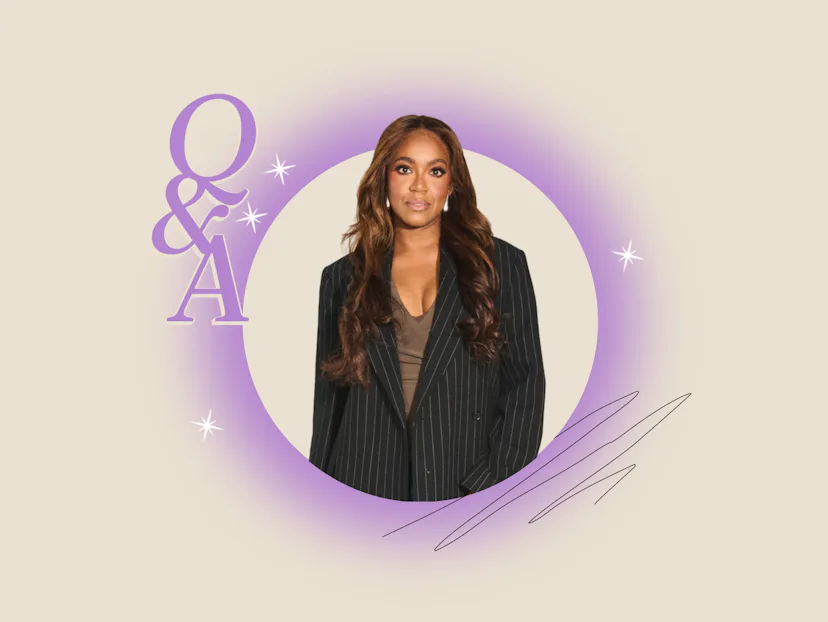
On the heels of a whirlwind spring theater season, many in the business like to take it easy in the summer. Not Whitney White: In between directing a revival of Whoopi Goldberg’s one-woman show at Lincoln Center Theater, she’s shuttling back and forth to the Manhattan Theatre Club, where she’s sitting in on auditions for the upcoming Broadway premiere of School Girls; Or, The African Mean Girls Play.
It’s an industriousness you’d expect from one of the industry’s most promising and talented directors. The Chicago native’s Broadway directorial debut, Jaja’s African Hair Braiding, earned her a Tony Award nomination in 2024, and last season, she received another for Bess Wohl’s memory play Liberation. Her current project, a reimagined revival of The Whoopi Monologues, is running at the Mitzi E. Newhouse Theater through Aug. 30 and stars a powerhouse ensemble cast including Kerry Washington (through Aug. 2) and Tony winners Kara Young and Kecia Lewis. Goldberg’s show — which launched her career after it moved to Broadway in 1984 with the help of Mike Nichols — tells the stories of five Black women and how society often sidelines their experiences, from addiction to teen pregnancy to menopause.
“The way that Black women tell stories is valid and needs to be heard — and is entertaining and will give you meaning in your life,” White says. “One thing Whoopi said to me recently that is on my mind is that all of the characters weren’t necessarily based on Black people, but because she was a Black woman performing it, it became a political gesture. And I think that’s very powerful.”

When did you realize you wanted to go into theater?
I actually wanted to be a singer. That was really my first gateway to the performing arts. I was singing at such a young age because I went to a beautiful church on the South Side, and they had an incredible choir, and I also went to a Catholic school where we learned liturgical music. I was convinced I was going to be an opera singer, and then [I did] musical theater. But my world didn’t really open up into the bigger world of what theater is until I graduated from Northwestern and I started working as a professional actor in Chicago.
Did you go to the theater a lot growing up?
Yes! The first time I saw Les Mis [on tour], I couldn’t breathe, to be honest. I love Les Mis to this day. Le Mis and The Phantom of the Opera are two shows that really worked me out — big shows where you have all those people on stage, and there’s just so much emotion and so many bodies. It’s just visionary. And back then, we had the budgets. I think those were two gateway drugs.
Well, then, you’ve got to get to the Les Mis concert at Radio City later this month.
I’ve already requested tickets! [Laughs.] And then the plays of Lynn Nottage — I was an understudy on the premiere of Ruined at the Goodman Theatre. Lynn Nottage has written a canon that just humanizes Black women and all women. Her work really took over my life. I’ve always loved performing arts, but I also love going to concerts. I see live music more than I even go to the theater.
What kind of music did you listen to growing up?
Nine Inch Nails is probably my favorite band, and I’ve seen them live maybe seven times. Trent Reznor is a seminal artist who has defied space and time with his rigorous look at his own work and his ability to speak to storytelling through scoring films. But I also love reggae. I love jazz. I go to LunÁtico in New York with my husband as much as possible — I think it’s the best music club in the whole city.

What made you want to bring The Whoopi Monologues back?
The themes are unfortunately still relevant. We have a woman who’s an immigrant from Jamaica coming to the U.S. as a laborer in a very precarious way, no ticket home, and gets involved with this older white man who changes her financial future forever. We have a teenage girl who has an unexpected pregnancy and is trying to figure out what to do. We have a junkie with a Ph.D. who finds unexpected meaning in life that freaks them out. And we have a woman coming out of menopause who’s reinvestigating her purpose and meaning in life.
When Whoopi Goldberg first did this, she was making it because everyone kept telling her she couldn’t do something, so she was like, “I’m going to show you how I can do everything.” And this launched her career. I think about how she’s made a way not just for herself, but for all of us. And so now five women have performed this play, and I hope that 10 women do it, 100 women do it. I hope it goes all over the world.
What were your conversations with Whoopi as you were developing the show?
I went to her office with Lear deBessonet, [the artistic director at Lincoln Center]. We went up, and in comes Whoopi. And I have to say, I was starstruck at first, because this is a woman who has achieved so much across so many mediums. Here is this living legend. And she had someone print up these different versions of the script and then gave them to me. Being handed something in 3D by Whoopi Goldberg was unforgettable. I just tried to soak up as much as I could whenever we would speak. She remains this incredible voice. Her voice bears her truth, you know?
And when she makes a statement, people pay attention to her. What she says really resonates.
I think about how rare that is — that someone could go from a brilliant, one-act text-based piece of work to The Color Purple, to Sister Act, to Star Trek, to The View and being a political force in our modern times. That’s such a beautiful journey for an artist to have.
What was the first thing you thought about as you were re-imagining the show? Did you know you wanted to cast five different leads this time?
The first thing is: Storytelling is the basis of everything. You walk down the street in New York, you meet someone you don’t expect to meet, you learn their story, and a whole world opens up. And re-imagining it, I wanted to listen to the power of that. When you have the patience to listen to a stranger’s story, there’s gonna be a lesson in there for you.
And then in casting the five women, I wanted to find people who spoke to the essence of the monologue, and women who were wildly different from each other — because that is also a part of Whoopi’s power. When she came on the scene, she was extremely different from anybody out there — the way she presented herself, the way she talked, the way she walked, her vibe. And in this time of hypernormalization of plastic surgery and what we all should look like and think like and sound like, what’s cool and what’s in and what’s out — like, it’s still OK to be an individual, to be yourself.
What conversations did the show stir up for you personally? Did any particular story stand out or really hit you hard?
They all hit hard for me because they all have an unblinking kernel of truth. And sitting with that, I’ve had to ask myself, “Am I moving through the world in a way that is the most authentic and truthful to me?” And it’s made me clock when I am mincing words, when I am putting on the shroud of the politics of respectability, when I am, in a W.E.B. Du Bois-ian way, wearing the veil of consciousness — the double veil in a white space or a space that might not feel inviting to me. And walking away from this play, I’m asking myself, “Do I have to hide? What will happen if I don’t and if I’m just truthful? What happens if a woman is just truthful all the time?”

And it’s obvious that in 2026, there are still not a lot of women directors in the theater, let alone Black women directors. I’d love to hear your thoughts on that and what challenges the business still faces on those fronts.
More and more, I have less answers and more questions, because we’re no longer living in a time when anyone can say, “The talent is not there.” There was perhaps a time in which someone could say, “Oh, there’s not enough female directors who are at X level or have X and Y level of experience.” But now, I can speak the names, and I can not only speak the names, I can tell you the last critic’s pick they had; I can tell you their last success; I can show you where they’re artistic directors. I know that list now on both sides of the Atlantic, by the way. So now that the talent is out there, why are we not seeing their work, and why are they not getting the opportunity? What can I do? What can we do?
On a somewhat related note, I’ve been thinking a lot about Andrew Lloyd Webber’s comments this week about Cats: The Jellicle Ball closing much earlier than anyone expected, and his thoughts about Broadway’s prohibitive cost structure.
I was devastated to hear the news about Cats. It’s one of the most incredible revivals I’ve ever seen. When I’m directing something or leading a project and an issue occurs, I say to myself, “OK, the first step is to identify the problem.” And so, Andrew Lloyd Webber and countless others have identified we have a sustainability problem given the current economics of Broadway. I think we need everyone who has the keys to power to just acknowledge that, and then I think people need to come to the table with the solutions.
Someone once said to me, “You never know if you have the keys to someone else’s door.” And sometimes I wonder if it’s a matter of getting everyone to the table to think about what solutions they can offer. Because you might assume that the solution you have might not do it — but maybe it will if someone else has the keys to unlock that solution. I think every theater worker in the commercial arena, every theater owner, we all have to ask, “What are we going to do? What can we do?”
What was the best piece of directing advice you’ve ever gotten?
Phyllida Lloyd is a great inspiration to me, because she has worked across musical theater and film. We were a part of a Rolex protege and mentorship program, which was fantastic. And she said to me, “You’ve got to keep yourself together.” And I didn’t quite understand what she meant at the time. And now I really do, especially as a woman, as a Black woman. You have to really keep your mind, body, and spirit right so that you can enter the room as brilliantly and excellently and at the top of your game as possible, but also as a human being.
What does keeping yourself together look like for you? You've been a busy lady with Liberation, The Whoopi Monologues, and School Girls in the fall.
I keep myself together by going and doing the things that I love. I plan on seeing Nine [Inch] Nails an eighth time, a ninth time. Every time I read about a musician or a DJ that interests me, I wanna go, you know? I love museums. I just fell in love with a writer named Jacqueline Crooks who wrote a book called Fire Rush. It’s so phenomenal and follows the wild, harrowing, soulful escapades of a Jamaican girl growing up in London back in the day. And so I wrote to that writer, and now we’re in dialogue. So I take care of myself by filling my mind.
I also have a beautiful 3-year-old son who keeps me very busy, and watching him experience the world has filled mine with so much joy. You’ve got to keep chasing the things that make you feel inspired to engage with society.
