Daily Dish
Is Food The Greatest Relationship Challenge Of Our Time?
Relationships are hard enough. Preferences, restrictions, allergies, sensitivities, and most recently GLP-1-induced satiety have made aligning appetites a high-wire act. When did food become so all-consuming?
Recently, my friend Alison texted me a photo of her husband sitting in a beach chair eating an apple, his biceps notably more robust than in years past. She wrote: “If this man says ‘I don’t have the calories for that’ one more time, you might catch me on a future episode of Dateline.” Two years ago, he signed up for a virtual trainer and “accountability coach” to help him get in shape. Now, he’s 25 pounds down, nerding out on biohackery, and subsisting on 1,550 calories a day, mostly from prepackaged meals with calculated “macros.” Every time he pulls out his travel food scale, a device about the size of a Kindle, it sends a shiver down his wife’s spine.
In their home, meals have become a process of parallel play: He has his food; she has hers. Much of the time, this arrangement is relatively frictionless, since she travels almost every week for work. But on trips together, the disconnect is clear. “Vacations,” she says, “are a lot less vacation-y now.”
This isn’t how it was supposed to be. We once thought of food as a bonding experience, a love language. If we were lucky, it could even be an aphrodisiac. At the very least, eating was a thing best done in the company of other human beings. Bread — back when people ate bread — was made to be broken communally. Today, though, as eating habits and lists of food sensitivities become ever more individualized, it can seem like nobody just eats anymore. The food we consume together (and, increasingly, apart) is more likely to ignite a tug-of-war than a sensual awakening.
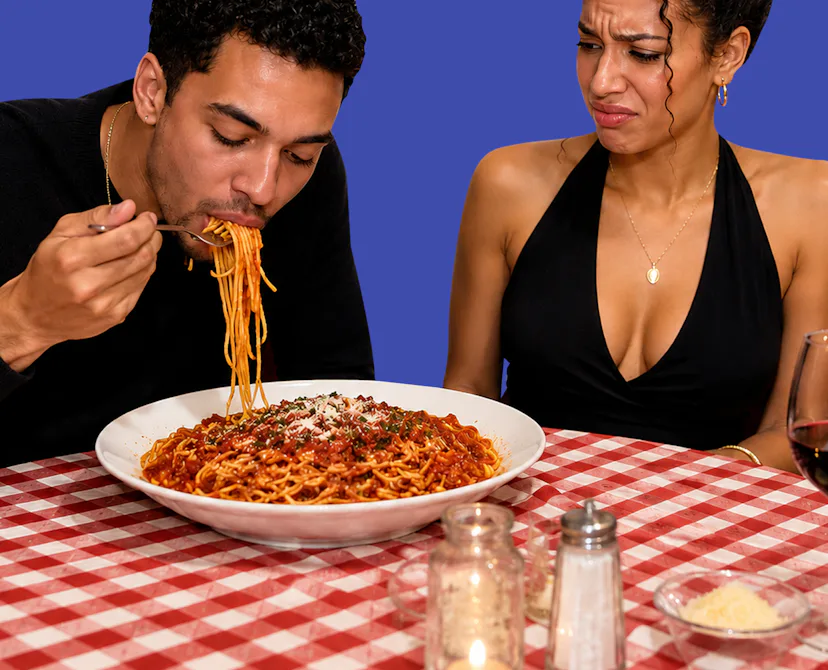
If Lady and the Tramp were to stroll into Tony’s Restaurant circa 2026, we all know how that would go: She’d want her spaghetti gluten-free. He’d fret about nightshades in the marinara. They’d both want more information on the provenance of the meatballs: Was the beef ethically raised and grass fed? Had Tony ever considered swapping arugula for dairy in his meatball recipe?
What is dating, after all, other than a ritual of choosing, consuming, and paying for food with a person we barely know? In the search for compatibility, this is the dance by which we telegraph our worldliness, manners, generosity, not to mention our basic humanity (are you the type of person who mentions the wad of kale betwixt the other person’s incisors, or do you let it ride?). Sometimes these signals tell us everything we need to know. People I interviewed for this article recalled dates who got dropped cold based only on a flavorless deli order (plain turkey on white bread, seriously?) or “the way she ate her pizza.”
I come from a Southern family in which labor-intensive sit-down meals are a love language and an act of civility. He considers the humble peanut-butter-and-jelly sandwich a perfect and complete meal.
Matthew, a 50-something creative director, recalls the guy who cooked “like Sandra Lee” (not a compliment). No amount of good looks could make up for “that tin of mushroom soup over broccoli with ready-grated cheese.”
Sloane, 34, who was diagnosed with celiac disease five years ago, notes that men on Hinge are increasingly fond of posting warnings along the lines of “don't date me if you don’t eat gluten.” If we wanted to give these suitors the benefit of the doubt, we might reason that they are trying to signal their rejection of diet culture and unrealistic body image, Sloane hypothesizes. But what a man like this is really saying, Sloane suspects, is that “he doesn’t want you to have needs,” she says. “He doesn’t want you to inconvenience his life in any way. He wants you to fold into his interests… and not have any bumps in the road.”
One benefit of having celiac, she says, is that it killed off the “charade” of pretending to be “the Cool Girl” — the fantasy persona made famous in the novel Gone Girl, who claims to love football, dirty jokes, and chilli dogs, all while suppressing her actual preferences, just to make men comfortable. A person who can’t eat wheat, Sloane says, is officially a person with needs of her own.
One wonders who these pro-gluten dudes have left to date. According to a 2024 Centers for Disease Control and Prevention report, 6.7% of U.S. adults have a diagnosed food allergy. But that’s a relatively small fraction of the picky eaters out there. Data from the annual survey by food and beverage industry nonprofit The International Food Information Council shows a clear arc. In 2018, 36% of Americans reported following a specific diet or eating pattern at some point in the past year. By 2025, that had shot up to 57%.
Add to that the 12% of Americans who are on appetite-suppressing GLP-1s like Ozempic, which can cause even a lifelong gourmand to lose interest in food, virtually overnight. “There is enormous pressure to get food right, exercise right, health right, body right,” says Bozeman, Montana-based marriage and family therapist Julie Menanno, author of Secure Love: Create a Relationship that Lasts a Lifetime. “And nobody really has the answers. Very few people feel like they’ve really got their food thing dialed in.”
For those who pursue a “palate-gap relationship,” a food disparity that first appears to be a small thing — a quirk to laugh off — has a way of becoming problematic over time, a pebble in the shoe that irritates countless nerve endings. Amanda, 48, who is in the early stages of a divorce, has lately been looking back on one of her first dates with her now-ex. That night, they shared plates at an Ethiopian restaurant. When she ordered a dish that was slightly sweet, he got upset: How could she have ordered something like that — didn’t she know he didn’t eat sugar? “How was I supposed to know that?” she says. Later, she learned that he was sickened by anything sweetened. Also, that his vegetarianism — an ethical choice that she respects — was so strict, he wouldn’t even touch vegetables cooked on the same grill as meat. These days, she’s taking inventory of where things went wrong. “How much of this is evidence that my marriage was a failure, versus, like, just weird food things?”
“We tend to dismiss food as this irrelevant thing, but we spend more time eating and preparing food than almost anything else in life,” Menanno says. “So it’s actually quite significant.” Besides the time we spend on it, food is embedded in our ideas about taste, love, pleasure, and sensuality. Not to mention woven in and around far bigger things: class, culture, finances, body image, gender, and the balance of domestic labor within a relationship and, later, a family. That’s before you even dip a toe in the quagmire of “wellness.”
Sara, a mostly-besotted newlywed, admits that her new husband’s eating habits have presented “a real learning curve.” He is a creature of extremes whose pendulum swings between two distinct eating personalities: On one side is the omnivore who Hoovers up everything on his own plate as well as the leftovers she might have been saving for later, plus “the whole box of cookies, leaving half of one behind.” On the other is the king of clean: When her man decides he needs to cut back, he goes all the way, becoming ultradisciplined, even ascetic, cutting out sugar and carbs and surviving on tiny portions. “I exist in a middle ground,” she says, “and he’s skating the extremes on either side of me.” This often means they each do their own thing, come dinnertime.
Does meeting a partner’s needs — attachment and otherwise — have to mean consigning oneself to a life of subpar pizza, or a legume-free existence?
My own marriage can be a teeter-totter of food misalignment, in more ways than one. My husband and I fundamentally differ on the significance of food and how much production it should require: I come from a Southern family in which lengthy and somewhat labor-intensive sit-down meals are both a love language and a critical act of civility. He fundamentally believes food is fuel. I’m not calling him a Philistine; I’m saying he’s… pragmatic. This is a man who would rather order takeout when friends come over than spend hours making a feast. He considers the humble peanut-butter-and-jelly sandwich a perfect and complete meal.
Funny thing, though: This is where his simplicity ends. For while I have been blessed with an iron gut, his list of food sensitivities is both real and ever evolving. When he eliminated gluten in his 20s, his life was genuinely changed; and when we met, I got on board with that pretty easily (though I have been known to wistfully stroke the boxes of “real” farfalle at the grocery store). When he cut back on lactose, I benevolently went along with that too — look at me, being flexible! (In truth, I cannot remember whether he prefers almond or oat milk, which even to me feels a little passive aggressive.) Then, a couple of years ago, he came home with a book about a low-FODMAP diet, a wide-ranging elimination regimen for the digestively challenged. This would have required him to break up with a list of items that have no apparent through line, other than together they comprise most of what we know as food. Everything from apples to asparagus — and that’s just the “a” produce — plus all legumes and most dairy. And honey. Honey? “Oligosaccharides blah fermentation blah,” he told me.
Turns out, my ability to accommodate food sensitivities has a breaking point, and that breaking point is garlic and onion. Give me alliums, or give me death! As our family’s head chef, the one who shops for, plans, and makes most of the meals consumed by two adults and two picky-eaters-in-training, this is where I hit a wall. What could I cook if I didn’t have garlic and onion? (You don’t have to answer that.)
Of course, it’s never really about the food. For nearly four decades, Terri Orbuch — a distinguished professor of sociology at Oakland University and the author of Five Simple Steps to Take Your Marriage from Good to Great — has been overseeing what is now one of the country’s longest-running studies of marriage. Her project tracks 373 couples who married in 1986 via surveys, questionnaires, interviews, and observational sessions. Over the years, roughly 46% of the couples have divorced; some participants have been widowed; some of these singletons recoupled. The result, she says, is a pretty clear picture into what predicts whether a couple will last.
Do food discrepancies really matter in the long-term health of a relationship? In short, that depends on how much they matter to you. According to Orbuch, we all have “important beliefs you orient your life around,” she says. “When you wake up every morning, it’s ‘this is what’s important to me; this is how I’m going to organize my life.’”
She calls them key life values. They could be about finances, whether we spend versus save. They could be prioritizing time with a big extended family versus time one-on-one as a couple. For some people, food — particularly as it relates to being proactive about health and fitness, or to beliefs that reflect a broader life philosophy, such as veganism — rises straight to the top of the list.
In Orbuch’s research, the biggest indicator of whether a couple will stay together, and stay happy, is whether their top 2 key life values align. “How important is it that you orient your life around what you put in your refrigerator, what restaurants you go to, what you eat?” she says. “These seemingly small incompatibilities are really underlying a larger belief about health and fitness.”
Menanno throws out a hypothetical: You’re trying to decide where to go to dinner, and your partner suggests the pizza joint that offers gluten-free. You respond, “Can the whole world really all of a sudden be allergic to gluten?’”
The problem here is not your willingness to suffer through another gummy crust. Menanno says it’s whether your partner’s attachment needs are being met. Just as parental attachment makes us feel safe and loved as children — and shapes our ability to feel that way as adults — secure attachment in a relationship makes us feel validated, appreciated, understood.
Food is embedded in our ideas about taste, love, pleasure, and sensuality. Not to mention woven in and around far bigger things: class, culture, finances, body image, gender, and the balance of domestic labor.
If you’re the kind of monster who would, say, roll your eyes at the idea of eliminating FODMAPs — and by extension, at your partner’s quest to finally feel good in his own high-needs body — “what the other person may hear is: ‘My needs aren’t important to you. I’m not being seen,’” Menanno says. “‘Are you even curious about my experience? Do you even know me?’” When these unmet needs take root, “then anger comes in, and then fear: ‘Are they ever going to see me? Is this going to be forever?’”
OK, fine, I’ll say it. Does meeting a partner’s needs — attachment and otherwise — have to mean consigning oneself to a life of subpar pizza, or a legume-free existence? Not necessarily. It’s about how you message it. (Though a therapist probably wouldn’t cosign that marketing speak.) “The answer is not being dismissive. The answer is being curious,” Menanno says. “As in ‘I want to lean in and understand you. I know it’s really hard to deal with all of this, and I have compassion for that.’”
For what it’s worth, the person with the growing list of dietary specs — or the cute new travel food scale, or the sugar-free manifesto — has a role to play here too, and part of it is being cognizant that their voyage of self-discovery sometimes asks a lot of their partner. Alison is able to cope with her macro-counting husband because at least he maintains his sense of humor about himself. “He knows he’s a lot,” she says. Self-awareness seems like the very least a born-again health nut could, er, bring to the table.
Whatever the food disconnect is, experts agree that it must be dealt with, preferably sooner rather than later. Orbuch says “don’t sweat the small stuff” is not always great relationship advice. The small stuff has a way of getting bigger and more intransigent, and calcifying over time. The longer you wait, the harder it gets to unpack.
A friend who spent her 20s as a “pesca-vegan” once stumbled upon a unicorn: This guy was cool, made great money, owned a beautiful apartment, and was also pesca-vegan. To friends, she referred to him as Pete the Homeowner. Suddenly, instead of worrying about being “that girl” with the picky eating habits, forever scanning menus and finding nothing to eat, she had Pete the Homeowner — somebody who just got it. Boundaried eating was their lingua franca. “It was dreamy,” she says, until Pete the Homeowner ghosted her. Food compatibility is nice when you can find it. But it isn’t everything.
Self-awareness seems like the very least a born-again health nut could offer.
When David met Charlotte, he was a subsistence eater whose favorite restaurant was KFC, raised on recipes his mom clipped out of Southern Living. In their house, “salad” was a scoop of cottage cheese on top of a canned pear, served in an iceberg lettuce leaf. (Don’t knock it till you’ve tried it.) Charlotte, meanwhile, was the product of a French father and an artist mother who loved the impossibly sophisticated, labor-intensive recipes of L.A. food icon Suzanne Goin. David’s family had always quickly finished their meals and then stood up, moving on to whatever came next. In Charlotte’s house, the table was a place to linger for hours, through the rollout of multiple courses and conversational topics.
This sharp contrast could have been an early deal-breaker, or festered for years as a class divide between two families. Instead David now sees it as “one of the greatest strengths of our relationship.” Through his wife, he learned to “embrace food and joy.” The first time he started cooking, it was to impress her; he made Julia Child’s Gratin Dauphinois out of a copy of Mastering the Art of French Cooking that his mother had gifted to him for the endeavor. Over the years, he has become not just a talented and confident home cook, but a palate adventurer, an apostle of abbondanza, the kind of dad who lovingly tortures his kids to try every weird thing he puts on their plates. “I eat anchovies!” he says. “Not in a million years would I have expected that.”
For the record, Charlotte’s horizons have also expanded. Through her mate, she learned the simple truth that a McDonald’s Filet-O-Fish — forbidden in her rarified childhood for a thousand reasons, only some of them nutritional — is one of life’s great delicacies.
