In Session
My Therapist, My Fantasy Lover, My God
It was a regular patient-shrink relationship. Until it became an all-consuming obsession.
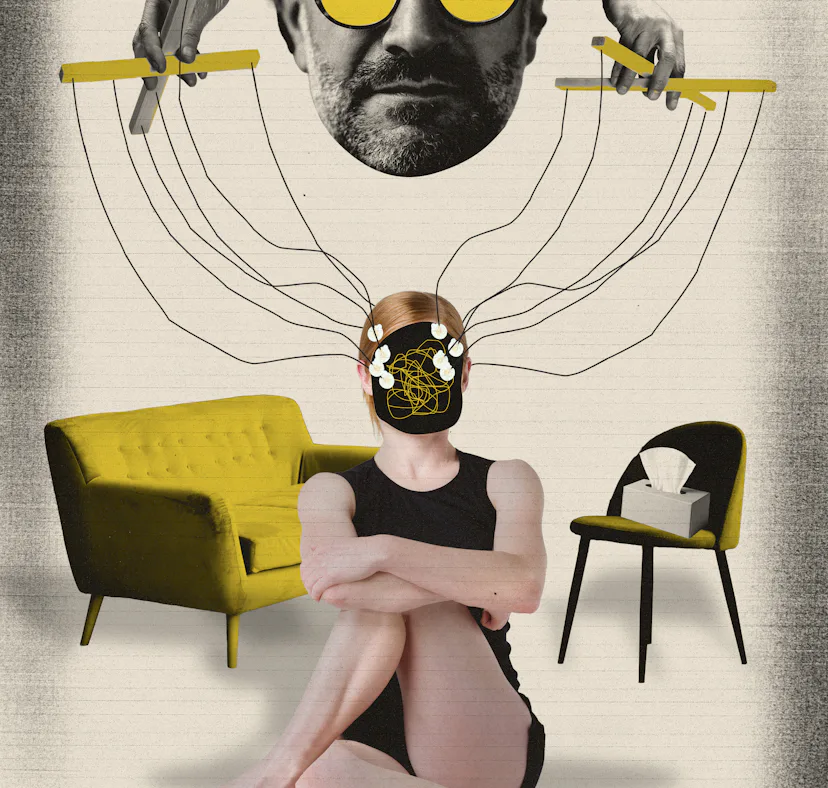
“My novel,” I finally told my therapist one morning, 18 months after I’d started seeing him, “is about a woman dangerously obsessed with her psychotherapist.” And not just any therapist — one with questionable motives and a penchant for encouraging his patient to share details of her sexual fantasies. The man across from me didn’t look fazed. “You’ve created a character you can control,” he said. He took a beat, then added: “Because you can’t control me.” He was correct, of course. But there was more to the picture.
I knew very little about therapy when I first met Dr. Webb (not his real name). My general practitioner had recommended therapy to help with the anxiety I was experiencing around the publication of my first novel and my upcoming relocation from London to New York. My husband, Erik, had moved there a year earlier for a new job, and although I was excited about joining him, I was leaving behind a teaching role that I loved. For a year, I’d flown back and forth every school holiday, but it was too hard to be apart for long stretches at a time. “Some therapy couldn’t hurt,” I told myself as I scheduled my first appointment with one of the three therapists my doctor had suggested. Looking back, I wonder why I selected Dr. Webb. The other two therapists were women specializing in cognitive behavioral therapy. It is unsettling to imagine how different my experience would have been if I made another choice.
I felt lighter after my first therapy appointment. The anxieties and fears that I’d been keeping at bay finally found space to land with Dr. Webb. He had a soothing Irish accent and a way of listening intently, his gaze held steady. I was encouraged by his gentle approach to asking questions and guiding me through difficult emotions, and I thought this was how our work would continue. But after four consultations, Dr. Webb laid out his treatment plan: We would be doing psychodynamic therapy, which meant that I should say exactly what I was thinking and keep a record of my dreams and that he would be more silent than in our initial sessions. That was all he told me, no explanation of how this worked or what the effects could be. In our next meeting, I admitted to him that I found these instructions to be impossible. Like so many women, I had spent my life censoring myself to obtain approval. How could I be a good patient if I didn’t know what he wanted me to say?
“Perhaps you don’t know what to say to me,” he said, echoing my concern, “because you don’t know what to say to make me like you.”
“I don’t know anything about you,” I replied. And he nodded, for the first time slipping into the silence that would come to drive me mad. Over the next few months, he frequently guided our discussions away from my real-life anxieties about moving and giving up my job and toward the dynamic between the two of us: my desire to know if I was getting therapy “right,” his refusal to disclose anything at all. At this point, I began to think about him constantly — and not just inside our sessions. Did he like me? Did he care about me? Did he move on when our sessions ended, or did he think about me all week, too? I found myself longing to be held by him, a feeling that he returned with blank silence. Soon my desire to know if he cared for me began to shift into darker, more confusing, more overtly sexual fantasies. How could I have developed this deep attachment to a man I knew nothing about beyond a resume on his Psychology Today page? Shame and self-disgust began to creep beneath my skin.
“You think we’re having an affair,” he said to me. “You’ve used therapy as a project to try and make me fall in love with you.”
At first it seemed like an ordinary case of transference — the way patients project past feelings onto therapists. There is positive transference (seeing the therapist as a tender parental figure), negative transference (when the therapist seems manipulative or sadistic), or erotic transference (when the therapist becomes the object of sexual or romantic longings and fantasies). I experienced Dr. Webb as a benevolent god, a manipulative sadist, and a commanding lover all at once.
The online advice I sought out, desperate to understand what was happening to me, was clear: Patients experiencing transference must tell their therapists, and the therapists will help their clients understand what is happening as a path to easing the symptoms of the transference.
And so, after many false starts with my heart racing, and long silences where I wondered whether I’d ever be able to say the words, I told him how much I was thinking about him between sessions, gesturing at the fantasies I couldn’t shake.
This is when I should probably explain that up until this point, I hadn’t met Dr. Webb in person. All my appointments had been online.
“I wonder whether you’d like to start meeting in person,” he replied matter-of-factly.
“I’d like that,” I said, my chest tightening. I added, “But do you see your other patients a mix of online and in person?” It was my best shot at trying not to betray the enormity of what he was saying.
“It really is idiosyncratic,” he said. “But I can tell you that right now I’m seeing all my patients only online.”
And there it was: evidence that I was special to him. Or something more frightening — and thrilling: that he’d interpreted the erotic transference I’d just confessed to as an invitation.
I hardly slept the night before our first in-person appointment. When I arrived at Dr. Webb’s office, a quiet rented room in a small psychotherapy clinic in London, I was terrified. In our previous online session, he’d talked about seeing me “in the flesh,” and I was unsettled — but not deterred — by his choice of words. When he opened the door and led me through the silent corridor, no sign of another therapist or patient in the building, I did not know what I wanted more: for him to reassure me that I was safe with him or for my fantasies to come true. The reality of the appointment was far more painful and frustrating. He pressed me to tell him more of what I felt about him while at the same time giving away nothing of himself. It was as though I was stripping myself naked only to be faced with silence.
“You think we’re having an affair,” he said to me, and I shook my head, embarrassed. I did not think that, but this was the first of many instances where he told me what he thought I was thinking and, gradually, I found myself believing him. “You’ve used therapy as a project to try and make me fall in love with you,” he said to me one day a few months later. Although I tried to resist his interpretations, over the course of our in-person sessions, I started to fall for them. If I could believe that he cared for me, that I was his favorite patient even, then perhaps I could find a way to like the parts of myself that the therapy was revealing.
Occasionally, I’d have a moment of clarity and decide things were getting too intense, too weird. But when I tried to leave, he persuaded me to stay. He insisted that I give a month’s notice if I wanted to end, and in those four weeks, he’d convinced me that I would not cope without the therapy.
Confession didn’t bring relief. Instead, my body began to destroy itself from the inside out at an alarming pace.
Six months into the therapy, he began pressuring me to up our cadence to twice a week. I resisted for a few weeks, but he would not let the subject go; he attributed the tension regarding our schedule to some past behavior or desire, related to how men in the past had treated me, repeating itself. I eventually agreed, then changed my mind a day later in a fit of panic about how I’d given in to him. But he would not accept my decision to go back to my normal single weekly session. When he sent me my monthly invoice, I was surprised to see that he’d charged me for four sessions that I hadn’t attended. This was not an accident. Instead, my refusal to go along with the extra sessions, he said, meant that something from my past was playing out with him. Always, when I challenged him or questioned the purpose behind what we were doing, he told me I was turning him into a sadistic figure. Every question I asked was pathologized, a symptom of my inability to let myself need him.
And yet I kept trying to make the therapy work, the writer in me drawn to the creativity of exploring dreams and fantasies. But the reality of this was deeply painful. When I opened up, he’d ask me to dig deeper, telling me I’d feel better if I told him the intimate details of my imaginary world — particularly, it seemed, when he was at its center. And I tried, desperate to be the model patient who did as she was told.
Confession didn’t bring relief. Instead, my body began to destroy itself from the inside out at an alarming pace. An old eating disorder resurfaced. I punished my body with a feverish exercise regime, and I was diagnosed with an autoimmune disease. What terrified me most were my sudden and overwhelming urges to self-harm. I told Dr. Webb, of course, and asked him for support with how to stop, but his suggestion that it was an outlet for my guilt about the feelings I was having about him only intensified my compulsion.
Relief came five months into my therapy, when I moved to New York to be with my husband, and my sessions with Dr. Webb became virtual once again — with occasional in-person meetings whenever I was in London. Erik’s steady and boundless love kept me from entirely losing my grip on reality. Still, it was a source of terrible shame for me that I’d reached a place in my therapy where I believed the only person with the power to truly help me was Dr. Webb.
I had no experience of therapy prior to Dr. Webb, and — no matter how or how often I asked — he would not explain the mechanics of the work we were doing together. But I could not let go, and while one day I’d feel an urgent compulsion to leave, the next day I’d long to strengthen the connection between us. When we talked about my weight loss, he said that perhaps I didn’t know what weight to be because I didn’t know at what weight he would find me attractive. At this, I broke down, caught in a bind of hating that he had made the conversation about him but also feeling that he was correct. I did want him to find me attractive.
“I’m falling apart,” I told Dr. Webb, pleading. “Can we try something different? Can you help me find a way to cope?”
“You can fall apart with me,” he said, fanning the flames of my attachment.
But wasn’t it his responsibility to at least try to help put me back together again?
For the intimacy of therapy to feel safe, the therapist is responsible for creating a secure therapy frame, a set of consistent and predictable boundaries that provide a container for the vulnerable work to take place. For me, this was where things went wrong. I pushed at the edges of the therapy frame, testing for weak points. And I learned quickly: “Tell me how much you need me,” it felt as though he was saying, “and I’ll give you more time. Tell me your fantasy about me, and I’ll meet you in person. Try to leave, and I’ll reply to your email.”
When we talked about my weight loss, he said that perhaps I didn’t know what weight to be because I didn’t know at what weight he would find me attractive.
I had lost my ability to trust my instincts. His refusal to acknowledge that his behavior was contributing to how terrible I was feeling made me worry that I was going mad. But I could not recognize what was happening: I was addicted, stuck in a cycle of intense highs, triggered by breadcrumbs of affection — extending a session by 10 minutes, holding my hand — then followed by deep downward spirals as he rebuilt the walls.
“I want you to hold me,” I said to him in an online appointment the week before meeting him in London.
“I know you do.”
“And will you?”
“Why don’t you ask me when you see me?”
And then, sitting across the room from him a week later, I was too frightened to say the words. “I don’t usually do this,” he said, “but I want to let you know we only have a few minutes left.” I forced myself to ask him if he’d hug me, knowing I’d regret it if the session ended and I didn’t see him again for months. “I’m afraid not,” he said, “but we can shake hands.”
Later, looking back at this moment, it interested me that he’d described it as shaking hands. For what happened next was not that at all. As he held my hand, a tight grip that I did not want to end, I asked him again if he’d hug me.
“If I don’t hug you, you think there’s something wrong with you,” he said. “You can’t feel that I’m holding your hand.”
“I do feel it,” I whispered, my head close to his chest, our bodies centimeters from each other.
I knew then that I was in too deep. I felt that I’d humiliated myself by asking him to hug me, and I was angry that he’d not been clearer with me in the previous appointment. But I had another secret: A few months earlier, I had begun seeing another therapist, one who was gradually helping me trust myself. Therapy with her could not have been more different than with Dr. Webb. Although she, too, practiced psychodynamic therapy, in combination with other approaches, she always discussed how it would work with me before introducing them, giving us the space to reflect on whether I was informed and therefore could consent to the work we were doing. She was in a therapy practice in New York, and that reassured me that she had colleagues and a supervisor and clear policy documents — a stark contrast to the mysterious unknowns of Dr. Webb’s practice. She allowed me to see that my concerns were valid.
I wish I could say that solved it — I saw both therapists for about a year — but it did help me realize when I finally, truly, had to walk away. Erik and I were excited about starting to try for a baby. My New York therapist helped me with my anxieties about getting pregnant, guiding me to a place where I felt confident that I could approach all these uncertainties without falling apart. But when I told Dr. Webb that I was trying for a baby, the first thing he said was to ask if I knew that I’d get bigger when I was pregnant, sewing doubts into my mind about whether I’d cope. I realized I could not see him while I was trying to get pregnant, not if I wanted to avoid more stress than I could safely manage.
And so I left Dr. Webb, a stressful and prolonged ending that dragged on for four weeks of him trying to persuade me to stay and four further weeks of him saying he’d stay available during our session time in case I changed my mind. It took immense self-control not to return during those final four weeks, and away from him, I began to painfully stumble through all that was left unresolved. I replayed our most conflicted conversations from the past two years over and over, unable to find closure even with the help of my New York therapist. It felt as though something essential was missing from my life, as though I’d let go of a rare relationship that had shaken me to my core while at the same showing me parts of myself that I’d tried to hide for years. I thought back to his suggestion to meet in person two years earlier, seeing it in a new light. Perhaps it was an attempt to remove my shame, to show me that nothing I said to him was too much. That I was not too much.
“I’m falling apart,” I told him, pleading. Wasn’t it his responsibility to at least try to help put me back together again?
I was pregnant and into my second trimester when the grief of leaving him felt like too much to bear. I missed him and the freedom he had offered me to explore all parts of myself. At the same time, I found that I was reinterpreting his words in less obsessive ways, no longer worrying incessantly about what motivated him to treat me the way he did. I reached back out.
When I returned to his practice, it was a reassuring surprise to see that Dr. Webb was as content talking with me about motherhood as he was encouraging me to share the details of my fantasies. We took a few weeks at the start to discuss how our work might be different during my pregnancy, and although he never explained any ways that he might change his approach, I could tell that he was listening to me. The way each session ended became kinder and less abrupt. He was willing to play a part in discussing the transference with me rather than leaving me to try and understand it on my own. Pregnancy and then motherhood helped me see him as an ordinary man, no longer a god or savior or sadistic lover. I stopped pushing at every boundary, and he found a gentler approach to our work together.
Did writing The Model Patient, my novel about a dangerous relationship between a therapist and patient, give me the understanding I needed to be able to move forward in my therapy? Did it give me the control I craved in our dynamic? I will never be certain. I started writing the novel during my first year of therapy, when our relationship was at its most confusing and volatile, and at that time, a creative outlet felt essential, my own way to contain the chaos of my emotions when the therapy felt too much. But I know now that an intellectual understanding is very different from an emotional one, and all the theory in the world is not a protection from the retraumatizing effects of an intense transference-based therapy relationship.
“Did I need to suffer so acutely for us to find a way to where we are now?” I asked him not long ago.
“You’re still angry with me,” he replied in his typical way of not answering my questions.
Yes, I’m still angry with him. But perhaps therapy needs anger if it is to reach into the most tender, hidden parts of oneself. Or do I tell myself this to justify my decision to stay with Dr. Webb? I do know that for many months after returning to him, the only person who knew I’d gone back was my husband, Erik. It took several more months before I told my New York therapist, and even longer before I told close friends and family. How could I explain that I’d willingly reengaged with the man who had caused me so much pain? Although Erik continues to believe that Dr. Webb is negligent, is dangerous, and completely failed in his duty of care, I like to think that there is no danger anymore. Now, with the raw wounds of the first two years healing, I trust Dr. Webb, but more importantly, I trust myself. When our 50 minutes end each week, I can stand up, take a deep breath, and get on with my day.
The Model Patient will be published on April 14 by Union Square & Co., a division of Hachette.
