Mani Report
I’m A Lifelong Nail Biter. Could Japanese Gel Finally Break The Cycle?
An investigation.
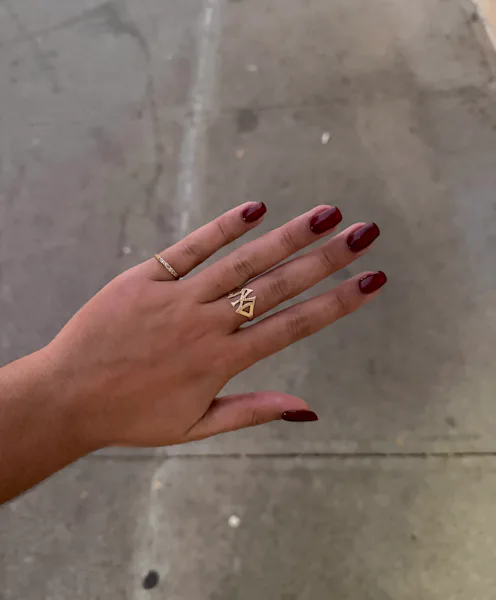
As a lifelong nail biter, I’ve sabotaged plenty of perfectly good manicures. One little chip, and it’s my cue to peel off all the gel and pick at my cuticles until my fingertips look like they’ve been through a wood chipper. Needless to say, it’s time to take my natural nail growth journey seriously.
For years, press-ons have been my saving grace. At least they hid the damage I’d already done, even if all that nail glue was only making things worse in the long run. Then, a month ago, I was shopping for my next set at Ulta when an employee’s nails caught my eye. They extended well past her fingertips, long enough to file into my ideal almond shape, and didn’t have a single chip. I complimented her on them, and she told me they were natural. Of course, I needed to know her secret. Turns out, she'd been getting Japanese gel manicures for the past two years — and absolutely swore by them.
As a beauty writer who spends an embarrassing amount of time researching nail trends, I couldn't believe I had never heard of Japanese gel. I'd tried just about everything else — dip powder, Russian manicures, Gel-X, you name it — but somehow the one treatment that promised to keep my natural nails from bending and breaking had flown under my radar. So I booked an appointment at Peach Bling in New York City to see if it could finally convince me to give up my press-ons once and for all.
What Are Japanese Gel Manicures?

On paper, a Japanese gel manicure might not sound all that different from your typical salon appointment: Your nails get prepped, then comes a base coat, color, and top coat. However, unlike a traditional gel mani, the Japanese style puts more emphasis on giving your nails extra support as they grow.
“With regular gel polish, it's usually soft and doesn't have a structure," says Sandra Wei, owner of Peach Bling. “Your nails may bend, and the polish may chip.” Japanese gel, on the other hand, gets packaged in a pot instead of a bottle and has a slightly thicker texture — similar to American builder gel, except it’s less sticky and bulky.
That consistency makes Japanese gel a good option for filling in ridges and creating a smooth finish, but structured Japanese manicures take things a step further. Instead of painting on the base coat in one even layer, nail artists build a slight apex over the natural nail. “It’s thicker in the middle, but very thin around the edges,” Wei says, comparing it to a bridge. The idea? To reinforce your nails and help prevent breakage. In other words, Japanese gel won’t make your nails grow any faster, but it can help you protect your progress.
Benefits Of Japanese Gel
Apart from the obvious appeal of helping you retain length, Japanese gel manicures have a few other perks.

For starters, many salons — including Peach Bling — use formulas that are free of HEMA and TPO. HEMA is a common ingredient in gel polish that can trigger allergic contact dermatitis, particularly if uncured gel comes into contact with the skin. TPO, meanwhile, was banned in EU cosmetics as of September 2025 over concerns about its potential reproductive toxicity. That doesn't mean they're irritation-proof, of course — other ingredients can still cause reactions.
The maintenance process may also mean less wear and tear on your nails. Instead of removing everything and starting from scratch, Japanese gel artists file off the old color and “rebalance” the base structure — AKA fill in new gel on top.
“We always keep the majority of the gel intact,” says Wei, adding that a full removal is only necessary if the gel has lifted or if someone wants to take a break from gel altogether. Read: There's less need to repeatedly file down your natural nail.
Another bonus? While regular gel polish typically lasts around two weeks, Japanese gel has a little more staying power, thanks to its harder texture. In fact, three to four weeks is the typical window between appointments, and Wei says most of her clients only come in once a month.
Of course, the trade-off is that Japanese gel manicures tend to cost a little more and take a little longer than traditional gel appointments. For example, prices at Peach Bling start at $98 for a one-color set without nail art or previous gel removal — and I would factor in an extra 15 minutes or so. But if you're used to getting your gel refreshed every two weeks, stretching that window to three or four could help offset the higher upfront cost. (At least, according to girl math.)
My Experience


As someone who gets fidgety while sitting in nail jail (AKA the salon chair), I was pleasantly surprised that my appointment at Peach Bling only took an hour — and that included removing my previous gel, too.
My nail tech spent about 20 minutes on cuticle prep alone, sparing no attention to detail. I don't think my bare nails have ever looked better. And compared to the Russian manicures I've tried before, it felt much gentler — no bloody tissues over here.
However, I’ll admit: I was a little nervous about the whole builder gel thing. After all, I was trying to grow out my natural nails — not look like I was wearing press-ons. Luckily, the Japanese formula was runnier than I expected, so any fear about ending up with a bulky mani quickly dissipated.
To create the supportive gel structure underneath, my nail tech brushed the clear formula onto one nail at a time, then flipped my hand upside down, palms facing up. Turns out, gravity helps the gel pool in the center, creating that little arch. She used a tiny brush to perfect the shape and thin out the edges, then quickly set each nail with a portable curing light before putting my whole hand under the larger lamp.
By the time she applied my red cat-eye polish on top, you never would have guessed that I had an extra layer of gel underneath. My nails looked just as thin as they would with a regular manicure, except they didn’t bend when I pressed on them.
The Verdict

It’s only been a week since my appointment, but so far, I’m impressed. My nails haven’t chipped, so I haven’t been tempted to give in to my gel-peeling habit. And when I spent a day pulling heavy boxes of winter coats out from under my bed for a fall closet swap, my nails didn’t bend — much less break.
Since my nails are already the longest they’ve been in years, I’m hoping the extra support will keep them that way. Before my appointment, I was literally having nightmares about them breaking and ruining my progress. Now, I can say I’m a lot less worried. Sure, it’s a little pricier than regular gel, but the peace of mind alone feels worth it to me. Case in point: I’ve already booked my next Japanese gel mani.
