The Entertainers Issue
Cara Delevingne Writes Her Own Story
She always hinted at her musical talent. Her debut album was still a revelation.
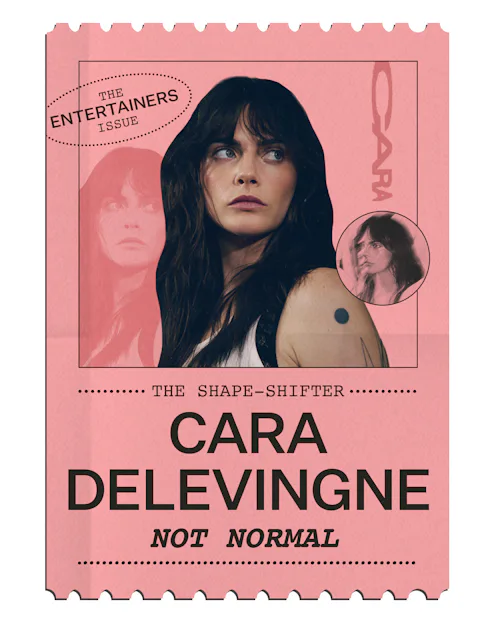
All month long, Bustle’s annual The Entertainers Issue is celebrating the performers and creators who lit up our screens and beyond in 2026.
In her decade and a half as a top model and actor, Cara Delevingne has had to embody all kinds of characters. But in 2026, she embraced her most revealing role yet: musician. After years of teasing her talents — like lending backup vocals to Fiona Apple’s “Fetch the Bolt Cutters” — Delevingne finally put her voice front and center with her debut album, Not Normal. “It wasn’t an easy three and a half years, but also it kept me sane. I’m so grateful for music in that way,” Delevingne, 34, says of writing the record. “I’m such a protector of the craft. Why it took me so long to even venture into it is because I wanted to be in the right place to be able to do it.”
The “right place,” she explains, is sobriety — the journey to which she viscerally captures on Not Normal. Even in the streaming era of genre fluidity, the album defies categorization. Co-produced by BJ Burton (Charli XCX, Bon Iver), Not Normal translated Delevingne’s loneliness and disorientation into a controlled cacophony of screeching synths, clanging drums, and unpredictable melodies that start on one plane and end on another entirely.
“It’s basically like having no skin and all the nerves are on the edge of you and you just feel everything,” says Delevingne, who recruited Severance cinematographer Jessica Lee Gagné for some of the album’s tense visuals. But Not Normal is hardly a downer, either: “Crazy, Baby” — a sweet love song to her partner, the musician Minke — has an irresistible hook straight out of ’90s alt-rock radio, while “Looking for You” is a burst of electro-pop delirium with credits from indie duo Sylvan Esso.
Delevingne is headed to the dance floor elsewhere this fall in Club Kid, the new A24 comedy-drama from Jordan Firstman. She plays Sophie, the business partner of Firstman’s Peter, whose hedonistic life as a gay party promoter is upended by the discovery that he has a 10-year-old son. After premiering at the Cannes Film Festival in May, the movie rose to the top of must-see lists and already has awards-season buzz. “I couldn’t be happier for Jordan. He really had a dream and kept pushing it and doing it. It’s a reminder to keep dreaming, to really chase those dreams,” Delevingne says. “Even if they don’t work out, I just think it’s important to chase things in life. Even if mistakes are made, it just teaches you a lot about life.”
On why she waited to start her music career:
Not being a sober person, I was so all over the place, and was on the edge of so much self-hatred, that putting out music and people having judgment on that — I just wouldn’t have been able to handle it. Back then, I could just about cope with people telling me I’m not pretty or ugly or not good at acting, but I couldn’t deal with [scrutiny over my music]. I just wouldn’t have been able to hack it.
On the album’s genre-pushing sound:
I wanted this to sound like nothing else that exists, and I want this to come from a pure place of emotion: This is what I’m going through. Honestly, a lot of these songs were way crazier. We fully set sail, and then we were like, “Maybe we should draw it back in a bit.” But that was important because I felt like I was alone and going through something no one had ever gone through before — that’s a pretty selfish way to think of it, but that was how I wanted it to sound.
On reintroducing herself as a musician:
I 100% worried about [putting myself out there]. I just tried to focus on what I wanted to make and what was an accurate portrayal of that. Nothing like that has ever stopped me before, I suppose. I will never stop making art because of other people’s opinions. Imagine if artists stopped making music because of others’ opinions. It would be so bad. Even if it was going to be bad art to people, I’d rather make bad art than none at all. I have to create — it’s really important for me, for my psyche. If no one sees it, it doesn’t matter.
On the visual world of Not Normal:
I was confused by how the visual side of an album was done because I think a lot of people, specifically after Brat, were like, “What’s your color?” I was like, “I don’t know!” To me, this is multicolored. I just want to feel like I’m floating in space and things are happening around me — but space feels really empty, and this album doesn’t. I made a mood board for it with really abstract-looking photos. One of them was Jessica’s, and it’s a photo of a puddle, and in the puddle are clouds. I was using a lot of things where you don’t know if they’re real or not.
When I first started speaking to Jessica, I didn’t tell her a lot. She was not too keen about making a music video. She was like, “That’s just not something I’m interested in.” I just gave her the album to listen to. I always wanted to make a video of “I Forgot” into “Out of My Head.” They blend seamlessly into each other. She was like, “[What about] making a video of these two songs together?” I was like, “Wow, that’s so crazy. We’re on the same page.”
On working with pal Fiona Apple:
The verses of [“Need It”] were written through us sending pictures of Post-it Notes back and forth to each other, which is now a weird thing to think about. Why did we not just send a Notes app screenshot? But we were like, “I need to write this down on a Post-it Note and send it!” You can’t really hear her as much in the music, but she’s just been an inspiration to me as a person and as an artist. I absolutely adore her.
On getting involved in Club Kid:
Jordan [Firstman] and I met out at parties, I think in LA, which is so cliche. He said to me, “I have an amazing movie I’m making. I want you to play a role.” People say that a lot in LA, so I was like, “Sure.” And then he actually sent it to me, and I was like, “Oh my God, this is sick.” It was so cool and queer and different. Big Daddy was one of my favorite movies growing up, so a queer, druggie Big Daddy? I saw the vision. Jordan’s hysterical. He’s so alive. I was like, “If you can bottle this and put it into a movie, it’s going to be incredible.” And it is. [The opening scene] felt like a perfect capture in time of being in 2016.
On appearing in Taylor Swift’s “Patient Zero” video:
I remember hearing [the song] for the first time and going, “How long is it going to be until this song comes out? I can’t wait to have it on repeat.” I remember her calling me up with the idea for the video when I was driving home. She’s like, “I have an idea.” I was like, “OK!” I love working with friends. It’s the most incredible thing. But the scope of it, the idea, every single detail, the Easter eggs, all of it — it’s unfathomable how someone can do all of those things and do them so well. She’s a genius, she really is.
