Bustle Exclusive
Chapter 1 Of Sophia Benoit's Bawdy New Romance Novel
The Very Definition of Love is like Bridgerton meets Emily Henry.
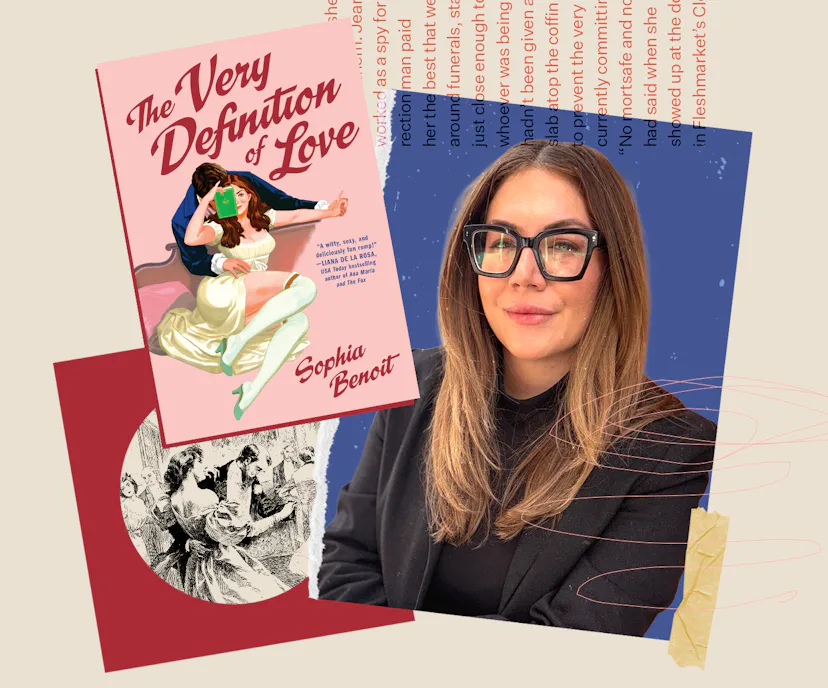
In this exclusive excerpt from Chapter 1 of The Very Definition of Love (out June 23), Sophia Benoit —who also writes Bustle’s dating advice column, It’s a Pleasure — whisks readers away to 1816 for a Regency romance in the vein of Bridgerton meets Emily Henry. Meet Harriet Bancroft, who is secretly compiling a delightfully bawdy dictionary, as she prepares for the ball that will set in motion her unlikely romance with Lord Alexander Stirling.
Harriet loathed dancing. More accurately, she loathed watching people dance. Which is what she normally did at balls. There were so many better uses of her time, like reading, or sending words to Mr. Dawkins, or keeping her sisters away from their father, or their father away from the gambling tables. Normally, the prospect of leaving for a ball within the half hour would have her filled with dread.
The few times she had danced, mostly during her debut season, had proved disastrous. Unfortunately, as the eldest unmarried daughter of the Earl of Tidewell, dancing—or observing dances—was to be her lot in life for a little while longer. It was as unspoken as it was obvious that Harriet was not likely to marry after five unsuccessful seasons, but no one had any definitive answers for when she might be allowed to beg off the charade.
Harriet would have gladly married the nearest available man simply to get out of attending balls; however, this was not an option available to her. Her elder sister, Philippa, had already strained the bounds of propriety with her marriage six years ago, and was now, as a widow, further testing society’s limits. Any damage Philippa hadn’t done to the Bancroft family’s reputation, their father had taken care of.
Of course, this overlooked the chief reason Harriet didn’t just marry the first man she brushed past at a ball: Gentlemen always seemed to have better options about, and those options were so often her own sisters. When coerced into attendance, Harriet spent balls holding wineglasses and eyeglasses, lending a hairpin or mending a hem, watching as Philippa and Caroline danced with and dazzled haute society.

But tonight was going to be different. Oh god, she hoped it would be different. According to his latest letter, Mr. Dawkins had arrived from Oxford last week and was to be at the Dunley ball. Lady Dunley took pride in just how full her ballroom could get and didn’t mind inviting a few non-peers if it meant that the season started with a crush. Tonight was about one thing, and one thing only:
“Your breasts,” Philippa said.
“My what?” Harriet sputtered, stiffening in her seat at Philippa’s—rarely used—davenport desk.
She had arrived at her sister’s house dressed in her best gown, ready to leave for the ball, only to find that Philippa had not even begun her preparations. Typical. Caroline, already too beautiful for anyone’s own good, was taking advantage of Philippa’s well-trained lady’s maids and her large stock of hair ribbons and baubles.
“Oh, I do beg your pardon, would you prefer another term?”
Philippa drawled, as she was being helped into a pair of silk stockings—a task which Harriet felt didn’t necessitate assistance. “What other words are there for them?”
Harriet almost answered—bosom was not unheard of, décolletage if you were feeling French, booby if you were being naughty, and apparently dairy, although that felt quite vulgar indeed; globes, apples, paps—but most people, including her sisters, weren’t actually interested in words.
Mr. Dawkins was, though. Whatever time was left over after running the household for their father—begging servants not to leave, writing them glowing letters of recommendation in her father’s hand, learning to mend and sweep and wash and cook in their stead, bargaining with the butcher and flattering the fishmonger—Harriet devoted to the dictionary. The dictionary of slang and cant words she and Mr. Dawkins had been working on for months, though they’d never met.
“Well, what about them?” Harriet grumbled, trying not to sound as irritable or as interested as she was. Her sister did know something about enticing men.
“Like me, you have been blessed.” From the floor, where she knelt smoothing skirts, one of Philippa’s maids, Gertie, snorted. Philippa continued, ignoring her. “Yet you keep them completely hidden!”
Harriet fought back an unladylike groan. This again. Another lecture from her sister about her appearance.
“She’s right, you know.” This came quietly from Caroline, who sat across the room having her hair expertly curled by another maid in Philippa’s employ.
“Not you too,” Harriet moaned.
Philippa twisted her entire body toward Harriet, thwarting Gertie’s attempts to fasten a string of pearls around her neck. “Harriet! I’m quite serious!”
Caroline continued without moving an inch, ever the embodiment of grace. “Harriet, you know how rare it is that I agree with Philippa, but if you are to garner any attention at all tonight from your Mr. Dawkins—”
From Philippa’s bed, where she was reading outdated scandal sheets, their youngest sister, Frances, sat bolt upright. “Mr. Dawkins will be there? This is the first ball I’ve ever been sorry to miss!”
“I don’t think Mr. Dawkins is interested in my... breasts,” Harriet informed the room, reaching up to pat at her modest low bun. Still pinned in place. Still simple.
Everyone grew silent. Harriet finally looked around. “What?”
Philippa and Gertie screamed with laughter. Frances looked at her like she was the biggest cabbagehead imaginable. Even Caroline’s lips twitched with mirth.
“My dear,” Philippa said sagely, as if she were thirteen years rather than thirteen months older than Harriet, “I can assure you Mr. Dawkins is most interested in your breasts.”
“He doesn’t know they exist,” Frances said from the bed, not looking up from her periodical. “Did you know that the Duke of Waverly has fathered a child with an opera singer?”
“Frances, that sheet is from January, we all know, and of course Mr. Dawkins knows she has breasts!”
“Can we all stop talking about this? Please?” Harriet begged.
Everyone ignored her, as usual.

“Father doesn’t allow us to buy scandal sheets, Philippa! So how would I know? You get to have all the fun!” Frances continued. “And Harriet signs all her letters to Mr. Dawkins as H. M. Bancroft. He has no idea that the person who has been writing to him has breasts. Or that she’s been pining after him.”
“I have not been pining—” Harriet began.
“Yes, you have.” Philippa cut her off, sizing up her appearance in the mirror. It was, as ever, to her satisfaction.
“Does he really not know that you’re a woman?” Caroline asked.
There was something so sweet, so pure about Caroline that Harriet felt she must always give her the truth.
It was damned inconvenient.
“No, he doesn’t know I’m a woman. I did not think it relevant to my work. He is interested in me for my mind, not my breasts. And besides—” She was cut off by everyone’s shrieking and squabbling. Philippa and Gertie were laughing again, no doubt at her. Harriet bit her lip in embarrassment. How did her sisters seem to know so much about men? How could they anticipate what men thought? What they liked? What lesson had Harriet missed?
“Well, tonight we are going to change that,” Philippa announced, and when Harriet looked up, she noticed that her sister was looking quite shrewdly at her.
“Philippa,” Harriet warned, knowing that an idea was taking root in her sister’s mind. Ideas were a dangerous thing for Philippa to be in possession of. The only person more dangerous with an idea was Frances.
“A splendid idea,” said Caroline, in full agreement with Philippa.
Heavens, the ideas were spreading across the room. Frances looked back and forth between Caroline and Philippa, and Harriet fought the urge to stand and block her view, as if perhaps that would keep Frances from joining in.
“Oh, yes!” Frances’s eyes gleamed, which was the most dangerous portent of all. Everything—everyone—started moving at once, and all the activity seemed to coalesce around Harriet herself.
“You’ll wear this,” Philippa insisted, sorting through a haphazard pile of dresses that lay on the bed. She pulled out a low-cut white gown, not dissimilar to Philippa’s own, save for the detailing. It was, if you had to choose one word, exquisite. And if you had to choose another, wanton. “You can borrow stays.”
“And Clothilde can do your hair too. She’s almost finished with mine,” Caroline insisted, referring to Philippa’s French and rather rude lady’s maid, who, it must be said, did a lovely job with hair if you could put up with her vexing attitude. Caroline could put up with anyone. Harriet wondered if Caroline even knew Clothilde was mean.
“Wear some of Philippa’s rouge! And the perfume she has, the one that smells of lilies!” Everyone turned to Frances. Frances, who wore trousers as often as skirts; who usually tracked dirt to the dinner table; who thought women who rode sidesaddle were cowards.
“What? Just because I can’t go to balls yet doesn’t mean I don’t understand all this frippery. I’m not an idiot, you know. I read all the same issues of La Belle Assemblée as you do. I daresay I dance better than the lot of you, as well.” This reveal stunned Harriet, conveniently giving Philippa enough time to pull Harriet up from her chair. Just as quickly, Gertie started flicking open the buttons running down the back of Harriet’s admittedly plain gown.
Caroline sprang into action next and after that, there was really nothing to be done. For as much responsibility as Harriet had when it came to her sisters, she had little control, which is precisely how she ended up in a corset instead of her normal unrestricted short stays, and slippers not a little too small for her, with rouged cheeks and her hair actually styled, smelling of lilies. Despite the discomfort and her better judgment, when Philippa’s carriage arrived at Lady Dunley’s ball, she had to admit to feeling at least a little bit beautiful.
And worse: a little bit hopeful.
−
Alexander loved dancing. He had discovered a natural talent for it early on and his skill only improved with practice. Besides, it gave one something to do at parties that wasn’t so dull as talking about pheasant hunting. Alexander had found himself genuinely enjoying dancing after a few balls his first season; his lack of reluctance—indeed his apparent pleasure in the activity—endeared him to women of all stations.
Above all else, Alexander loved dancing because ladies loved dancing and Alexander loved ladies. What was there not to like about a physical activity that brought another person gratification? Alexander happened to adore activities that fell into that category, of which there were quite a few.
He was rarely without a partner, despite being a second son, and a rumored bastard at that. Although one didn’t need rumors to tell them what their eyes could plainly see: Lord Alexander Stirling was not the product of marital relations between his mother and the Duke of Belhaven any more than a lion could be the product of a chicken and a rooster.
Alexander’s jet-black hair and substantial height would have been enough to convince anyone that a minor Venetian prince was his true father, but it was his languid confidence and easy charm that separated him the most from his parents. Not that anyone remembered much about his mother, who was rumored to be in the Americas now, or India, or even Cornwall, depending on whom you went to for gossip.
All anyone really remembered was that a flighty blonde had been the catch of the season some thirty years past, and that the ill-tempered Duke of Belhaven had been friendly enough with her money-chasing father to ensure a match. She’d given him a natural heir and a bastard spare, whom he’d been forced to claim as his own. What people didn’t remember, or more precisely didn’t know, was that at the sight of the bastard’s ink-black hair, the duke had sent his wife—the mother of his children—away.
Thus, as a child, Alexander knew few women outside of his household staff, all of whom were far too afraid of the duke’s wrath to coddle or comfort the young bastard. At sixteen, he’d sneaked out of Harrow School over Christmas holiday with a few mates and found his way into the arms of a young gap-toothed woman who charged him a shilling for an hour, then let him have a second hour for free when he didn’t try anything. After his fourth visit, she explained the purpose of women in her profession. Then she demonstrated. After that, he visited her thrice more, paid her a pound each time, asked her to teach him everything he needed to know, and then made up his mind never to go too long without female company again.
And he hadn’t.
Tonight, like many nights before, he found himself preparing for yet another ball. What many of his male peers overlooked was that balls were a fabulous arena at which to meet female company, even if one did not intend to offer marriage. One could tease a spinster, enchant a dowager, captivate a debutante, provoke a chaperone, embrace a widow, and tempt a hostess, only to end the evening in bed with a Cyprian who wouldn’t have been let in the doors.
While his male peers often spent balls comparing livestock and complaining about Parliament, Alexander forwent such topics. For him, economic matters were reserved for clubs and coffeehouses. Balls were for dancing and drinking. And above all else: women.
This evening he was forced, unfortunately, to break his personal rule. He planned to use Lady Dunley’s ball to meet with the heavenly— and widowed—Philippa Fanshawe, Baroness Ellerton, holder of vast swaths of land in the Lake District. Land he intended to purchase. It did chafe him a bit to sully such an evening with talk of money, but he hoped to balance the faux pas with the promise of pleasure.
Alexander wasn’t actively in the market for a new paramour, having a quite expensive and experienced mistress currently perched in a townhome in St. John’s Wood. His and Giuliana’s agreement was not explicitly exclusive; she often sported jewels Alexander was most certain he hadn’t purchased for her. He liked that she was not overly reliant upon him, or interested in his general whereabouts. While her indifference wasn’t false, he suspected she played it up a bit, correctly sensing that he was the sort to be alarmed rather than aroused by displays of devotion.
While discreet, Alexander had never been one to limit himself. That way lay stagnation and dissatisfaction. He wasn’t the sort to grow lovesick or possessive over his partners, and he never, ever offered promises of fidelity. He might meet with an opera singer on Thursday and an unhappily married marchioness on Friday.
And one would be a fool to turn down Lady Ellerton’s company in any form; she was one of the most beautiful women of the ton, and one of the few who could match his seductive capabilities. While he did not feel desperate for her affection, he was undeniably interested. Tonight, if Lady Ellerton found herself inclined to join him in bed, after they discussed the land she held in Applethwaite, Alexander would count himself all the luckier. They’d been circling each other for months now; it was only a matter of time.
