Wellness
Maybe Don't Throw Away Your David Protein Bars
A dietitian breaks down the confusion over the recent lawsuit.
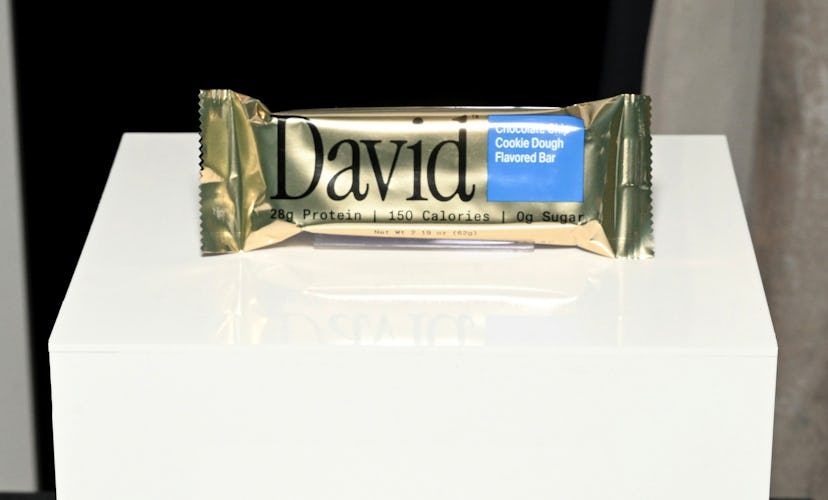
You remember Regina George's Kälteen protein bars in Mean Girls — the ones she ate in hopes of losing weight, only to realize they had more calories than she thought? The scene from the movie has been recirculating on social media after a class action lawsuit against a protein brand, but according to some dietary experts, the case is more nuanced than you might think.
The brand in question is David Protein. According to their site, “David helps anyone build strength, lose fat, and be beautiful.” The bars are reportedly designed to support muscle mass while decreasing body fat. (Yes, it is indeed named in honor of Michelangelo’s ripped statue.)
The brand quickly gained popularity after its launch in September 2025. The gold-wrapped bars became a go-to snack for models and influencers, with plenty of endorsements on social, including Candice Swanepoel and others. “This has better macros than some protein powders out there,” fitness creator @j_jungy said on TikTok last year.
So what’s the drama?
In January, three consumers filed a class action lawsuit alleging that David Protein misrepresented its nutrition information. The packaging says each serving contains 150 calories and 28 grams of protein (along with 12 grams of carbs, two grams of fat, and zero grams of sugar), but the lawsuit claims that third-party testing at Anresco Laboratories found they contain 268 to 275 calories and 11 to 13.5 grams of fat. The lawsuit argues that their labeling goes against FDA guidelines.
David Protein contests this. In a statement issued on the brand’s site, CEO Peter Rahal noted that the brand’s products are “labeled correctly and in full compliance with all FDA regulations.” He went on to add, “The claims in this lawsuit are meritless and reflect a fundamental misunderstanding of basic, well-established scientific principles regarding how calories are determined under U.S. nutrition labeling standards for ingredients like EPG.”
Well, what do the experts say?
According to Sahar Berjis, RD, a dietitian, nutrition coach, and CEO of Inner Health & Wellness, the discrepancy in calorie counts comes down to how the numbers are calculated. “A laboratory test measures the total calories present in the food, while nutrition labels often reflect the calories the body is expected to absorb,” she says.
David Protein bars contain esterified propoxylated glycerol (EPG), an ingredient you’d be forgiven for not being familiar with. “It’s a modified fat designed to give foods the creamy texture of fat while being only partially absorbed by the body,” she says. “Because our digestive system can’t fully break it down, some of those calories may pass through instead of being used for energy. That’s why it’s sometimes used in products that want the richness of fat — but with fewer calories attached.”
Since EPG isn’t fully digested, manufacturers may count fewer “usable” calories than the total number.
As Alix Turoff, a registered dietician, wrote in an Instagram post: “The lab that tested David bars used something called bomb calorimetry. The problem is that bomb calorimetry works by burning the food and measuring the heat released. It has no way to account for the fact that EPG isn't actually digested by your body. Nutrition labels aren’t based on how much heat food produces when burned. They’re based on how much energy (or calories) your body can actually use/absorb.”
That’s how David arrived at the 150 calorie count. “The FDA allows alternative calorie calculation methods for ingredients that behave differently in the body,” says Turoff. “EPG qualifies for this.”
That math looks a little different for everyone. “Digestion varies from person to person, so calorie number — whether on a label or in a lab — are always estimates rather than exact science,” she adds. The amount of protein you need varies based on your weight and level of activity, but in general, the U.S. Department of Health and Human services recommends 0.8 grams per kilogram of body weight daily. If you weigh 150 pounds (about 68 kilograms), aim for 54 grams per day.
According to Berjis, bars like David’s can still be a helpful source of nutrition but shouldn’t replace other forms of protein. “A well-made protein bar can provide 15 to 20 grams of protein, similar to what you’d get from foods like Greek yogurt or eggs,” she says. “Think of bars as a practical snack — useful when you’re on the go, but not a replacement for balanced meals.”
How have people reacted online?
The Mean Girls connection certainly sent tongues wagging, but David’s social team have leaned into the drama, with a cheeky response spoofing some of the different rumors about the product. Watch the video below.
Source:
Sahar Berjis, RD, dietitian, nutrition coach, CEO of Inner Health & Wellness
This article was originally published on
