Wellness
There’s A Reason The “Big Light” At Home Makes You Irrationally Angry
"You're not alone."
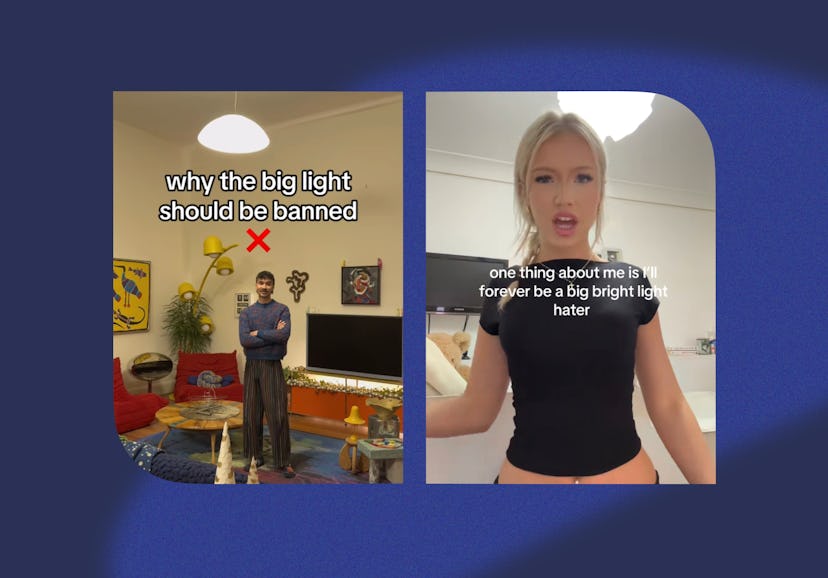
Many people have house rules that they take very seriously. No shoes inside, make the bed every day, and, in many cases, never, under any circumstances, turn on the “big light.” Don’t let your fingers linger near the switch, and don’t even think about flicking it on without warning. In fact, it’s best if you pretend it doesn’t exist at all.
If you’re a big light hater, this concept doesn’t need much explanation. It’s obvious that overhead lighting — often referred to as “the big light” colloquially — is way too bright, kills the mood, and might even put you on edge. In a viral TikTok, creator @joshandmattdesign said overhead lighting creates a sterile look, almost like you’re in a hospital, and that about sums it up. To brighten your rooms, go for ambient lighting instead.
It’s something @taylorbentl3y also likes to do. In a 2024 clip, she said, “One thing about me is I’ll forever be a big bright light hater,” as she lit candles and vibey lamps. Immediately, her room shifted from cold and clinical to warm and cozy. In her comments, someone said, “I literally get mad when someone turns on the big light lol.” Another wrote, “Big lights make me feel like I’m laid out on the operating table i HATEEEEEE IT.”
In another post, @tillystudytips said she only puts on the big light when she needs to clean. Because she despises it so much, she tidies faster so she can reward herself by turning it off ASAP. In her comments, someone said, “This was incredibly brave. I’m proud of you,” to which she joked, “Putting on the big light was more challenging than my whole degree.” Here’s why the big light rubs so many people the wrong way.
Why You Hate The Big Light

According to Dr. Stephanie Steele-Wren, a licensed psychologist, many people laugh about hating the big light, but they’re actually being 100% serious. “Behind the low-key joking is a genuine sensory experience,” she tells Bustle. “Overhead lighting tends to be bright, and it’s difficult to control its intensity, which can feel super overwhelming for a lot of people.”
It’s why many folks only turn on the big light to look for lost keys, a misplaced phone, or to quickly clean before turning it right off again. And sometimes not even then. If you’re easily overstimulated, the big light is almost always a no-go.
“This kind of light sends a continuous stream of visual information to the brain, and when someone has a lower threshold for sensory input, such a bombardment can feel intrusive and physically uncomfortable,” she says.


That said, even people without sensory sensitivities can find overhead lighting ugly and overwhelming. “It changes the mood of a space and makes it much harder to relax,” says Steele-Wren. “Most of us likely use very soft lit lamps in our homes instinctively, as do spas, most therapist offices — you get the picture.”
Bright, white, and overhead lighting sends a signal to your brain to be more alert, almost mimicking the sun, Steele-Wren says. “[It doesn’t cause] a dramatic spike in our stress hormones, but it is enough to make the nervous system shift toward alertness versus calm, which can feel like stress when someone is trying to unwind or is already dealing with other stressors in that moment,” she adds.
It’s why, when you want to chill in the evening, the first thing you do is flick off the overheads and light a few candles.
Dim Those Lights

Whether dim lights are your preference, a design choice, or a must-have for your mood, it never hurts to opt for subtler lamps or cozy candles. If you need more lighting while you cook, work, or get ready, full-spectrum lightbulbs can be a happy medium. They allow you to change the “temperature” of the light from warm to cool, and it can make a huge difference.
Softer lighting will reduce sensory overload and tell your nervous system that it can move out of fight-or-flight and into a more relaxed state, says Steele-Wren. “Many people notice physical changes pretty much immediately, like less muscle tension, slower breathing, and a quieter mind because there’s simply less sensory input demanding our attention.”
Even if you’re OK with using the big light, many experts recommend turning it off in the evening. “For sleep, this is a simple yet effective way to support the body’s natural winding-down process,” she says. “Low light lets melatonin, a major hormone regulating sleep, rise. Melatonin helps make the brain less alert and helps the mind transition away from stimulation and toward rest. Do a little self-experiment and try dimming your brighter lights right now and see how you feel.”
Studies referenced:
Gooley, JJ. (2011.) Exposure to room light before bedtime suppresses melatonin onset and shortens melatonin duration in humans. J Clin Endocrinol Metab. doi: 10.1210/jc.2010-2098.
Nair, AS. (2022.) A case study on the effect of light and colors in the built environment on autistic children's behavior. Front Psychiatry. doi: 10.3389/fpsyt.2022.1042641.
Source:
Dr. Stephanie Steele-Wren, licensed psychologist
